




26th February 2026BY Qasim Nihang
Canada’s New 2026 Express Entry Category for Physicians with Canadian Work Experience
Last edited: February 2026
Canadian physicians applying through Express Entry may qualify for IRCC’s 2026 “Physicians with Canadian work experience” category if they are in the Express Entry pool and have 12 months of qualifying physician work in Canada within the last 3 years under NOC 31100, 31101, or 31102.
You must still meet eligibility for an Express Entry program, most often the Canadian Experience Class or the Federal Skilled Worker Program. This category can improve your chances of receiving an Invitation to Apply, but it does not guarantee selection. Permanent residence does not authorize medical practice in Ontario, which remains subject to CPSO licensing requirements.
If you are a physician already working in Canada, 2026 may be the most practical Express Entry landscape you have seen in years. IRCC has introduced a dedicated Express Entry category for “Physicians with Canadian work experience,” which can move the right candidates in Canada to the front of the line, even when their CRS score would not normally be competitive in a general draw.
At the same time, Ontario doctors face a reality that immigration guides often skip: permanent residence is not a medical licence. Your immigration timeline, your work authorization, and your CPSO/MCC licensing steps need to fit into one calendar.
This guide explains the new physician category under Express Entry in simpler terms, shows how it relates to CEC and FSW, and provides a step-by-step plan to build an ITA-ready profile. We focus on Ontario risks we see regularly, such as weak employer letters, NOC mismatches, and timing gaps that can leave a doctor “invited but not ready.”
Reminder: This is general information, not legal advice. Always verify requirements on IRCC and Ontario regulator websites and get advice for your facts.
Quick Start: Pick Your Situation
If you have 12 months of physician work experience in Canada within the last 3 years and you qualify for an Express Entry program, this physician category can improve your chances of an invitation. If you do not have Canadian physician experience yet, focus first on Express Entry eligibility (often FSW) while building a Canada work-authorization and licensing plan in parallel.
IRCC explains category-based selection and the current categories (including this physician category) on its Category-based selection page. IRCC’s physician-specific pathway page is here.
Quick Start Checklist:
- I have 12 months (full-time equivalent) physician work in Canada in the last 3 years (NOC 31100/31101/31102).
- I qualify under at least one Express Entry program (usually CEC or FSW).
- My language test is booked or completed and results are valid.
- I have a work-evidence plan (letters, pay proof, schedule, supervisor contact).
- If CRS is low, I have a plan to improve language and/or explore a provincial nomination.
Figure 1: Quick Start Decision Flow
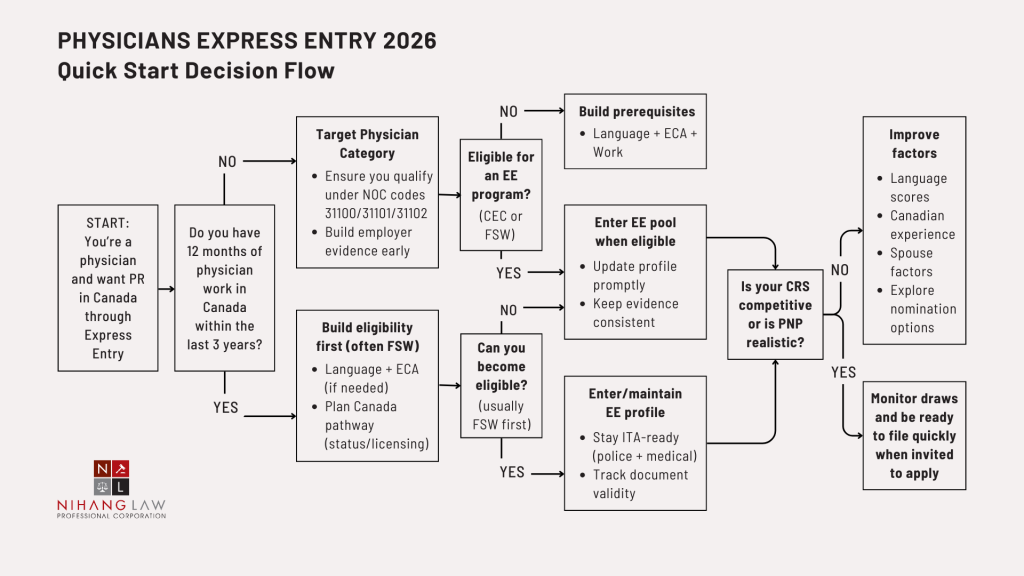
Note: This flowchart is a high-level guide only and doesn’t confirm eligibility; your next step depends on your exact Canadian work history and Express Entry program requirements.
Nihang Law Insight: For physicians, the fastest way to lose months is to treat Express Entry as a “form filling” exercise. Your strongest move is to build an evidence-first file: pick the correct NOC, then design employer letters and proof to match IRCC expectations before you accept an invitation
What is the “Physicians with Canadian Work Experience” Category?
This is a category-based Express Entry selection where IRCC can invite candidates from the Express Entry pool who meet physician-specific criteria. You still must be eligible under an Express Entry program (CEC, FSW, or FST), and you must meet the category requirements and the round instructions when invitations are issued.
IRCC describes category-based rounds and confirms you must be eligible for Express Entry on this page.
What it is NOT:
- It is not a medical licence (Ontario licensing remains governed by CPSO and related bodies).
- It is not guaranteed or permanent (IRCC can change categories and round instructions).
- It is not a substitute for program eligibility (you must still meet CEC/FSW rules).
Who Qualifies in 2026, and Which NOC Codes Count?
To be eligible for the physicians category under Express Entry, IRCC requires that you have accumulated, within the past 3 years, at least 12 months of full-time work experience (or equivalent part-time) in Canada in one listed physician occupation. The listed NOCs are 31100 (specialists in clinical and laboratory medicine), 31101 (specialists in surgery), and 31102 (general practitioners and family physicians).
The criteria and NOC list are set out by IRCC on the category-based selection page under “Who’s eligible for the physicians with Canadian work experience category.”
Figure 2: IRCC Requirements Snapshot
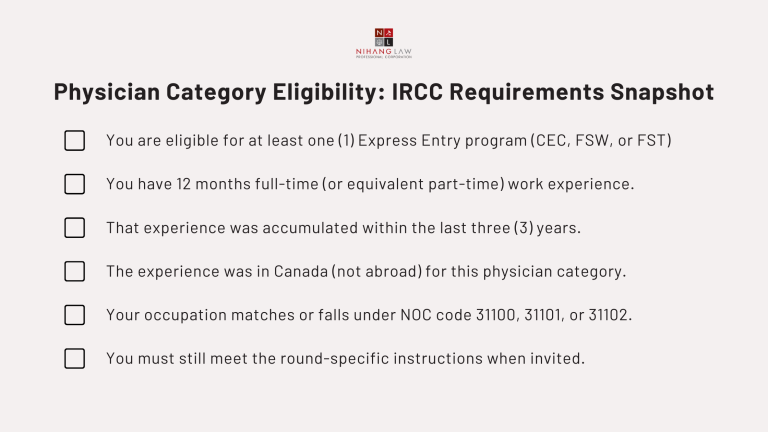
Note: This checklist is a simplified summary; IRCC assesses eligibility based on your specific documents, timelines, and the correct NOC match.
Evidence you should plan to collect:
- Employer letter(s) confirming title, duties, dates, hours, and compensation, aligned to the correct NOC.
- Pay evidence and/or contracts (to support full-time equivalency).
- A clean timeline (especially if you worked at multiple sites or under different departments).
- Any professional registration/licensing documentation relevant to your role (where applicable).
How Does This Interact with CEC vs. FSW and Why It Matters?
The physician category only affects who gets invited from the pool; it does not change the underlying program rules. If your qualifying experience is Canadian, you often fit CEC. If you rely on foreign work/education points, FSW may apply and may require an ECA. Your program lane determines what documents you need and what gaps can trigger refusal.
IRCC explains who can apply under Express Entry (CEC/FSW/FST) here. IRCC’s ECA page is here.
Nihang Law Insight: Physicians often assume “I’m already working in Canada, so CEC is automatic.” Not always. The safest approach is to confirm program eligibility first, then treat the physician category as a boost—never as your only plan
What Changed in 2025–2026 That Doctors Should Know?
Two changes matter immediately for physician applicants. First, IRCC removed CRS points for job offers effective March 25, 2025, so a job offer no longer boosts your CRS score. Second, as of August 21, 2025, Express Entry applicants must complete an upfront immigration medical exam before submitting a PR application after receiving an invitation.
What this means strategically:
- Do not expect a job offer to lift your CRS score; focus on language results, Canadian experience, and nomination options.
- Plan the upfront medical and police certificates early so you can submit a complete application within the deadline.
- Keep your Express Entry profile accurate and consistent with your documents to reduce refusal risk.
CRS Strategy in 2026: What Actually Moves Your Score Now?
In 2026, the biggest CRS levers for physicians are language results, Canadian skilled work experience, education points (including an ECA for foreign credentials where needed), spouse factors, and—in many cases—the “game changer” of a provincial nomination (worth 600 CRS points). Job-offer points no longer apply, so optimize the levers you can control.
IRCC explains CRS factors and additional points (including the job-offer change) on CRS criteria.
Figure 3: CRS Factors Bar Chart
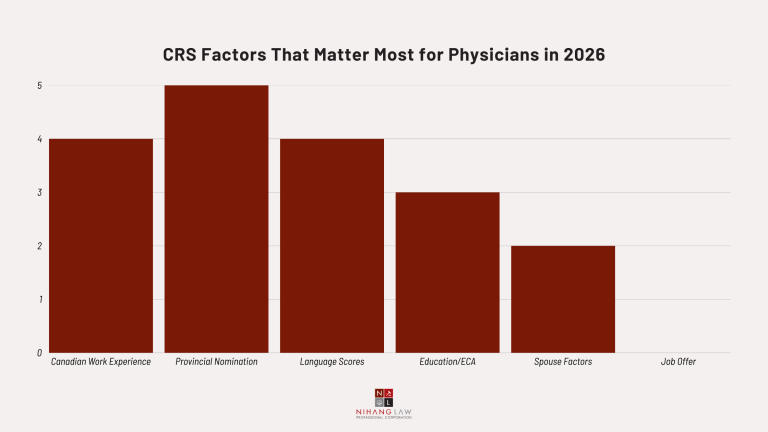
Note: This chart shows relative strategy levers, not guaranteed point gains. Your CRS outcome depends on your personal profile and IRCC’s current rules or draw criteria.
(These factors reflect typical impact on ITA chances under current rules and are not guarantees for PR.)
- Language proficiency: One of the fastest things you can improve, and it boosts CRS through core points and skill-transferability points.
- Canadian work experience: Increases CRS and can strengthen CEC eligibility and (for this article) meet the physician-category Canadian experience requirement.
- Education / ECA: Helps with education points and may be required for foreign credentials, but the extra CRS gain is often limited once education is already high.
- Spouse factors: Can add points through spouse language/education/Canadian experience, but the upside is usually smaller and depends on your family’s situation.
- Provincial nomination (PNP): Often the biggest ranking jump because it can add a large block of CRS points and quickly change ITA odds.
- Job offer (CRS points): Not a CRS factor under current rules because job offers no longer add CRS points (even if they matter for other pathways).
Practical CRS tip for physicians: If your CRS is borderline, the fastest “real” improvement is often language. Even fluent English speakers sometimes leave points on the table because they have not aimed for the higher benchmark thresholds that trigger additional points. In parallel, if your family situation allows it, plan spouse factors early (language, education documentation), because changes after an invitation can create delays or inconsistencies.
Ontario Reality Check: PR is Not a CPSO Licence
Express Entry and Ontario medical licensing are separate systems. Permanent residence can stabilize your ability to live and work in Canada long-term, but it does not authorize medical practice. Ontario registration is regulated by CPSO, and the MCC emphasizes that licensing requirements vary by province and must be confirmed with the relevant medical regulatory authority.
CPSO’s internationally trained physician guidance is here. MCC’s IMG pathways page is here.
Nihang Law Insight: Your best outcome comes from a single master timeline that includes: work permit expiry, Express Entry document validity dates, and key CPSO/MCC milestones. When those dates are misaligned, physicians often scramble after an ITA and risk missing a deadline or creating inconsistencies
Also note the provincial nominee angle for doctors. IRCC’s physician experience page highlights the Provincial Nominee Program pathway and indicates that provinces and territories will have up to 5,000 federal immigration spaces reserved to nominate medical doctors with job offers or letters of support. Even if you are focused on Express Entry, it is worth checking whether an Ontario nomination strategy is realistic for your role and site.
Step-by-step Roadmap: From Today to a Complete PR Application
A strong physician-category file is built in sequence: confirm your NOC and the 12-month Canadian experience rule, confirm program eligibility, secure valid language and (if needed) ECA, build evidence letters that match NOC duties, create/maintain your Express Entry profile, and prepare ITA-ready items like police certificates and the upfront medical exam so you can submit a complete application on time.
IRCC notes that after an invitation, you generally have 60 days to submit your PR application on this IRCC page.
- Confirm your physician NOC (31100/31101/31102) and map your day-to-day duties to that NOC.
- Count your qualifying Canadian physician work experience: 12 months full-time equivalent in Canada within the past 3 years (not necessarily continuous).
- Confirm Express Entry program eligibility (CEC vs FSW) and list every required document for your path.
- Book/complete your language test; gather education documents and obtain an ECA where needed.
- Collect employer letters and proof (pay, contract, schedules). Build a single chronological timeline for multi-site work.
- Create or update your Express Entry profile and track document expiry dates (language/ECA).
- If invited, complete the upfront medical exam and obtain police certificates early so your PR application is complete when filed.
Common Mistakes and Refusal Risks
Most problems are preventable. The most common issues are claiming experience that does not meet program rules, weak or inconsistent employer letters that do not match the NOC duties, expired or missing required documents (language/ECA/medical), and inconsistencies between your profile and supporting evidence. In Ontario, an additional risk is confusing immigration status with CPSO licensing requirements.
IRCC’s profile guidance is here.
- NOC mismatch: your letter lists a physician title, but duties are generic or do not align with NOC expectations.
- Fragmented evidence: multiple sites/employers with no clear combined full-time equivalency timeline.
- Assuming a job offer increases CRS (it does not).
- Waiting until ITA to start medical/police steps, then missing the deadline for a complete application.
- Licensing confusion: assuming PR authorizes practice or failing to align status expiry with licensing/employment milestones.
- Not updating the profile when facts change (marriage, job, work hours), creating inconsistencies.
How to Choose a Representative (Consumer Protection in Ontario)
You do not need a representative, but if you pay someone, they must be authorized. In Ontario, lawyers and paralegals must be in good standing with the Law Society of Ontario, and immigration consultants must be licensed by the College of Immigration and Citizenship Consultants. Always verify status on official registers before you share documents or pay fees.
IRCC’s authorized representative page is here. Verify Ontario licensees using the LSO directory, and consultants using the College register.
FAQ: Physicians and Canada Express Entry in 2026
Physicians usually ask the same questions: do I qualify, which NOC applies, does my Ontario role count as work experience, what documents are mandatory, and how to avoid refusal risks. The answers below are concise and designed to be read standalone, but you should get advice before relying on them for an application.
Do I need 12 months of Canadian physician work experience for this category?
Yes. IRCC requires 12 months full-time (or equivalent part-time) in Canada within the last 3 years in a listed physician occupation for this category.
Which NOC codes are included?
NOC 31100, 31101 and 31102 are listed by IRCC for the physicians with Canadian work experience category.
Does a job offer increase my CRS score?
No. IRCC removed CRS points for job offers effective March 25, 2025.
Do Express Entry applicants need an upfront medical exam?
Yes. As of August 21, 2025, Express Entry applicants must complete an upfront medical exam before submitting the PR application after an ITA.
Does PR mean I can practise medicine in Ontario?
No. Ontario practice is regulated by CPSO, and MCC notes requirements vary by province. PR and licensing are separate.
How fast do I need to submit after an ITA?
IRCC generally gives 60 days to submit a complete application after you receive an invitation.
What causes the biggest delays for physicians?
Work evidence issues: weak or inconsistent employer letters, unclear hours, and NOC duty mismatch—often across multiple sites.
Do I need a representative?
No. If you hire one, verify they are authorized through IRCC and Ontario registers first.
Final Reminder and How Nihang Law Can Help You
This category is a real opportunity for physicians who have already built Canadian experience, but it’s also evidence-heavy and timing-sensitive—especially in Ontario, where CPSO/MCC milestones and immigration status must line up. A good plan focuses on correct NOC selection, clean proof of experience, CRS optimization based on 2026 rules, and an “ITA-ready” document package.
Disclaimer: This guide is general information, not legal advice. If your facts involve multiple worksites, non-standard employment structures, or status/licensing timing issues, get tailored advice before you submit or accept an ITA.
If you need guidance with your PR journey, Nihang Law Professional Corporation typically supports physician applicants with:
- NOC/work-experience alignment review
- CRS strategy under current IRCC rules
- Evidence package design (letters, timelines, consistency checks)
- Risk screening (misrepresentation, document gaps, status issues)
Sources & References (Primary)
- IRCC — Express Entry: Category-based selection (includes physicians category criteria)
- IRCC — Medical doctors with experience in Canada (new physician category + pathways)
- IRCC — Job offer: Express Entry (CRS job-offer points removed March 25, 2025)
- IRCC — Medical exam requirements (Express Entry upfront medical as of Aug 21, 2025)
- IRCC — CRS criteria
- IRCC — Who can apply (CEC/FSW/FST)
- IRCC — Create your Express Entry profile
- IRCC — Educational Credential Assessment (ECA)
- IRCC — Authorized representatives
- CPSO — Internationally trained physicians
- MCC — Pathways for IMGs
- Law Society of Ontario — Lawyer & Paralegal Directory
- College of Immigration and Citizenship Consultants — Find an Immigration Consultant
- IRPA
- IRPR
Thank you for reading this post, don't forget to subscribe!