



19th March 2026BY Nihang Law
How Is Spousal Support Calculated in Ontario? Understanding the SSAG
Last updated: March 2026
Spousal support in Ontario is not determined by one fixed table. Where entitlement exists, lawyers and courts often use the Spousal Support Advisory Guidelines (SSAG) to estimate a range for amount and duration. The analysis changes depending on whether child support is also being paid. The SSAG are advisory, not binding law, and the outcome usually depends on income, relationship length, parenting circumstances, agreements, and the evidence.
Many separating spouses want one clear answer to spousal support: how much might be payable, for how long, and based on what formula? In Ontario, the answer is rarely a single number. Spousal support is usually assessed through a combination of legal entitlement, financial disclosure, and the SSAG, which provide ranges rather than guaranteed outcomes. The analysis can change significantly when child support is involved, and small differences in income, relationship length, parenting arrangements, or existing agreements can materially affect the result. Before relying on a rough calculator or informal advice, it helps to understand what the SSAG actually do, what they do not do, and how Ontario support cases are commonly assessed in practice.
Legal disclaimer: This article provides general legal information for Ontario readers and is not legal advice. Spousal support outcomes depend on the facts, the governing statute, the evidence, and the wording of any agreement or court order.
Quick Start: Pick Your Path
Married and separating or divorcing:
- Check whether support will be addressed through negotiation, a court application, or both under the Divorce Act.
Common-law and separating:
- Check whether you meet Ontario’s support definition of “spouse,” usually three years of cohabitation or a relationship of some permanence with a child.
Paying support already:
- Do not reduce or stop payments on your own because a court order or enforceable agreement usually continues until changed.
Seeking temporary help now:
- Interim support may be available before the case is finally resolved.
Trying to settle without court:
- The SSAG are often used in negotiations, but full financial disclosure still matters.
How is Spousal Support Calculated in Ontario?
In Ontario, spousal support is usually calculated by first deciding entitlement and then using the SSAG to estimate a range for amount and duration. The formula changes depending on whether child support is being paid. The result is usually a range, not one mandatory number.
The legal starting point is the statute, not the calculator. Under the Divorce Act, a court may make a spousal support order and must consider the spouses’ condition, means, needs, and circumstances. The Act also lists objectives such as recognizing economic advantages or disadvantages arising from the marriage or its breakdown, relieving economic hardship, and promoting self-sufficiency where practicable. The SSAG then help estimate what a reasonable support range may look like after entitlement has been established. They do not decide whether support is owed in the first place. That distinction matters because a plausible SSAG number does not, by itself, create a right to support.
Issue | Without child support | With child support |
Main income | Gross income | Individual |
Typical | Percentage of | Recipient |
Duration | Relationship | Relationship |
Child support | Not in play | Child support |
This is why two cases with similar incomes can still produce different support ranges if one case includes dependent children and the other does not.
Who Can Claim for Spousal Support in Ontario?
Married spouses may seek spousal support, and some unmarried partners may as well. In Ontario, the Family Law Act extends support rights to certain common-law partners, while the Divorce Act applies to married spouses in divorce proceedings. Which statute applies can affect both process and framing.
Under Ontario’s Family Law Act, a “spouse” for support purposes includes unmarried partners who have cohabited continuously for at least three years, or who are in a relationship of some permanence and are the parents of a child. That is why common-law partners may still have support rights in Ontario even when their property rights do not mirror the rights of married spouses.
What Must be Decided Before the SSAG is Used?
Before anyone seriously relies on the SSAG, there must be a legal basis for support. The threshold issue is entitlement. The Department of Justice guidance identifies compensatory, non-compensatory, and contractual bases for entitlement, and the SSAG are used only after that issue is addressed.
A compensatory claim often arises where one spouse’s earning capacity was affected by relationship roles, childcare, relocation, or uneven career sacrifice. A non-compensatory claim is more focused on need, hardship, and the financial consequences of the breakdown. A contractual claim may arise from a domestic contract or negotiated arrangement.
Nihang Law Insight
One of the most common mistakes in spousal support files is jumping straight to a calculator before confirming entitlement and income. A calculator can help estimate a range, but it cannot replace the legal analysis that comes first.
What Must be Decided Before the SSAG Can Be Used?
Before anyone plugs numbers into the SSAG, there must be a support basis in law. The threshold issue is entitlement. The DOJ materials identify three recognized bases for entitlement: compensatory, non-compensatory, and contractual. If there is no entitlement, the SSAG do not apply.
A compensatory claim usually focuses on relationship roles and economic sacrifice. Think of the spouse who paused career growth, stayed home longer with children, relocated for the other spouse’s work, or carried more domestic labour that helped the other spouse advance. A non-compensatory claim often focuses more on need, hardship, and the financial fallout of the breakdown. A contractual claim arises where an agreement creates or shapes support rights. The Supreme Court’s spousal support jurisprudence, including Moge and Bracklow, helped build the modern compensatory and non-compensatory framework that the DOJ materials now reflect.
This is why a pure income gap is not always enough on its own. The SSAG materials expressly warn that a disparity that produces a guideline number does not automatically create entitlement. That is a crucial distinction for both claimants and payors.
How Does the SSAG Formula Work Without Child Support?
In many without-child-support cases, the SSAG amount formula uses 1.5% to 2% of the spouses’ gross income difference for each year of cohabitation or marriage, up to a maximum of 50%. Duration often ranges from a half-year to a year of support for each year of the relationship.
This formula usually applies where there is no concurrent child support obligation. It is often the clearest SSAG formula for readers because it uses a gross income difference and a relationship-length multiplier. Longer relationships generally increase both the support range and the likely duration range.
Length of Relationship | SSAG Amount Range |
5 years | 7.5% to 10% of the gross income difference |
10 years | 15% to 20% |
15 years | 22.5% to 30% |
20 years | 30% to 40% |
25 years or more | 37.5% to 50% |
How Does the SSAG Formula Work When Child Support is Involved?
When child support is also being paid, the SSAG use a different and more technical formula. Instead of focusing on the gross income difference, the calculation is designed to leave the recipient with about 40% to 46% of the parties’ combined individual net disposable incomes.
This is where many online summaries become too simplistic. With-child-support cases are more calculation-sensitive because taxes, deductions, benefits, credits, and child-related arrangements all matter. The Department of Justice materials also emphasize that child support takes priority over spousal support, which can reduce or even eliminate a spousal support amount that might otherwise have been payable.
Nihang Law Insight
With-child-support cases often look straightforward until disclosure is reviewed closely. Section 7 contributions, benefit entitlements, parenting arrangements, and fluctuating income can materially change the range.
How Long Does Child Support Usually Last in Ontario?
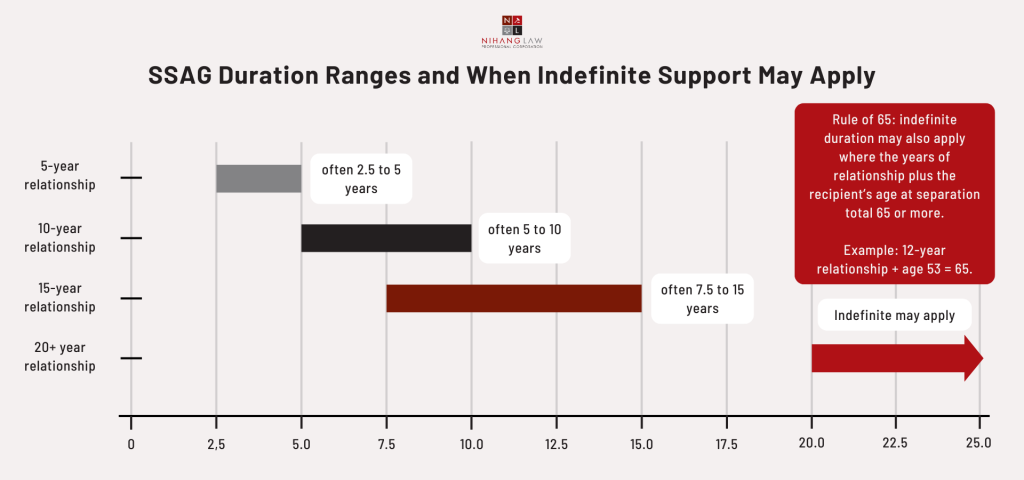
Duration is not automatic and is rarely expressed as one universal rule. In many without-child-support cases, the SSAG suggest 0.5 to 1 year of support for each year of relationship. In longer cases, support may become indefinite, meaning no fixed end date is set at the outset.
Under the SSAG, duration under the without-child-support formula becomes indefinite when the relationship lasted 20 years or more, or where the Rule of 65 applies. The Rule of 65 generally means the recipient’s age at separation plus the years of cohabitation total 65 or more. The Department of Justice guidance also stresses that indefinite does not necessarily mean permanent. It usually means no end date can fairly be set at the start, while later review or variation may still be possible.
Figure 1: SSAG Duration Ranges and When Indefinite Support May Apply
What Does the Step-By-Step Roadmap Look Like in an Ontario Support Case?
A typical Ontario support file starts with identifying the right statute and gathering disclosure, then moves to negotiation or court process, possible interim relief, and finally enforcement if support is ordered or properly documented in an agreement. Full financial disclosure is central at every stage.
A practical roadmap usually looks like this:
1. Identify the legal route.
Is this a divorce-based claim under the Divorce Act, a support claim under Ontario’s Family Law Act, or a negotiated separation agreement?
2. Exchange financial disclosure.
Ontario court guidance says a claimant or responding party dealing with spousal support usually needs Form 13, Form 13A, and supporting income documents. The motion-to-change checklist also requires proof of current income plus tax returns and notices of assessment for the last three years in support variation cases.
3. Start the case or formalize the agreement.
When support is first claimed in court, Ontario court staff issue an Automatic Order. Support can also be negotiated in a separation agreement rather than litigated immediately.
4. Address temporary needs.
The Divorce Act allows interim spousal support pending final determination, and Ontario’s Family Law Act permits interim or final support orders.
5. Use the SSAG properly.
Only after entitlement and reliable income information are in place should the parties seriously assess range, duration, and possible settlement.
6. Plan for enforcement.
Ontario’s Family Responsibility Office can enforce support orders, and Ontario court guidance explains that properly filed domestic contracts can also be enforced.
Nihang Law Insight
The fastest way to lose credibility in a support case is to file weak or incomplete disclosure. Even a strong legal position can unravel if your financial documents are late, inconsistent, or clearly incomplete.
When Can Spousal Support be Changed, Reviewed, or Enforced?
Support does not usually change just because life changed. A court order or enforceable agreement normally continues until it is varied, terminated under its own terms, or replaced. Under the Divorce Act, variation requires a change in condition, means, needs, or other circumstances.
The current Divorce Act says a court may vary, rescind, or suspend a support order, but before varying a spousal support order it must be satisfied there has been a change in the condition, means, needs, or other circumstances of either former spouse since the original order or last variation. Ontario’s motion-to-change materials then require updated support forms and income records.
That matters because people often stop or reduce support informally after job loss, retirement, or remarriage. But missed payments can still become arrears. Ontario states that court-ordered child or spousal support is automatically filed with the Family Responsibility Office, and the FRO’s job is to collect, distribute, and enforce support.
Remarriage or re-partnering is also commonly misunderstood. The DOJ’s SSAG user guide says remarriage does not automatically terminate spousal support, although it may justify reduction, suspension, or termination depending on the nature of entitlement and the new financial circumstances.
What Mistakes Lead to Inaccurate SSAG Calculations?
Most SSAG errors come from bad inputs, not just bad math. In practice, inaccurate support estimates often stem from incomplete disclosure, using the wrong formula, ignoring child-support priority, misunderstanding indefinite support, or treating online tools as substitutes for legal analysis.
Common mistakes include:
- Using a gross-income approach when the with-child-support formula should be used;
- Ignoring the statutory priority of child support;
- Plugging numbers into the SSAG before confirming entitlement;
- Assuming indefinite support means permanent support forever;
- Failing to update income evidence in a review or variation case;
- Overlooking the way benefits, credits, and section 7 contributions affect with-child-support calculations.
Frequently Asked Questions About SSAG and Spousal Support in Ontario
How is spousal support calculated in Ontario?
Spousal support in Ontario is usually estimated using the SSAG once entitlement has been established. The SSAG provide a range for amount and duration rather than one fixed number, and the formula changes depending on whether child support is involved.
What are the SSAG in Ontario?
The SSAG are the Spousal Support Advisory Guidelines. They were developed to make spousal support outcomes more predictable and consistent, but they do not decide entitlement and they do not operate as binding legislation.
Are the SSAG mandatory in Ontario?
No. The SSAG are advisory, not mandatory. They are widely used in negotiation and litigation, but courts still decide cases under the governing statute, the evidence, and the facts of the relationship.
How is support calculated without child support?
In many without-child-support cases, the SSAG use 1.5% to 2% of the gross income difference for each year of relationship, up to a maximum of 50%, with duration often measured at 0.5 to 1 year of support per year of relationship.
How is support calculated with child support?
With child support, the SSAG use a net-income model rather than a simple gross-income difference. The formula is designed to leave the recipient with about 40% to 46% of the parties’ combined individual net disposable incomes, and child support takes priority.
How long does spousal support last in Ontario?
It depends on the facts. In many without-child-support cases, duration is a range tied to relationship length. In longer cases, support may be indefinite, especially where the relationship lasted 20 years or more or the Rule of 65 applies.
What does indefinite spousal support mean?
Indefinite support does not necessarily mean permanent support forever. It usually means that no end date can fairly be fixed at the time of the order or agreement, but later review, reduction, suspension, or termination may still occur.
Can spousal support be changed later?
Yes, sometimes. Under the Divorce Act, support may be varied, rescinded, or suspended, but the court must usually be satisfied that there has been a relevant change in circumstances since the earlier order or last variation.
Can I rely on an online spousal support calculator?
Not safely on its own. A calculator may offer a rough estimate, but it does not decide entitlement, interpret agreements, resolve income disputes, or properly handle all of the inputs that matter in more complex SSAG cases.
Key Takeaways and How Nihang Law Can Help
Spousal support in Ontario is usually not about finding one magic number. The real sequence is to identify the right statute, assess entitlement, gather proper disclosure, and then use the SSAG to estimate an amount-and-duration range that fits the facts. Cases involving child support are usually more technical, and longer relationships raise more nuanced duration issues, especially around indefinite support and the Rule of 65.
A final reminder: a rough calculator, a friend’s experience, or a single headline figure is rarely enough to evaluate a support case properly. Support may be shaped by income proof, childcare realities, relationship length, agreements, and whether the matter is being started, settled, reviewed, or varied.
Nihang Law’s family law team can help you assess entitlement, review the right SSAG formula, identify disclosure problems early, and build a practical strategy for negotiation, a separation agreement, interim support, or a motion to change.
Sources & References
- · Divorce Act, s. 15.2 — Spousal Support Orders
- · Divorce Act, s. 17 — Variation, Rescission or Suspension of Orders
- · Divorce Act — Consolidated Federal Statute
- · Department of Justice Canada — Fact Sheet: Spousal Support
- · Department of Justice Canada — Spousal Support Advisory Guidelines
- · Department of Justice Canada — SSAG Revised User’s Guide, Chapter 4: Entitlement
- · Spousal Support Advisory Guidelines — PDF Version
- · Family Law Act (Ontario) — Consolidated Statute
- · Ontario Court of Justice — Family Case: Step-by-Step
- · Ontario Court Forms — Motion to Change (Rule 15) Checklist
- · Ontario Court of Justice — Support Enforcement Guide
- · Government of Ontario — Child and Spousal Support
Thank you for reading this post, don't forget to subscribe!