



31st March 2026BY Nihang Law
How IRCC Assesses the Best Interests of the Child in an H&C Application
- Mandatory, but not automatic: In the context of immigration, specifically in an H&C application in Canada, assessing the best interests of a child (BIOC) is a mandatory requirement under section 25 of the Immigration and Refugee Protection Act. However, a positive BIOC finding does not automatically guarantee that the overall H&C application will be approved.
The Supreme Court Standard: Decision-makers must evaluate the child’s circumstances in a real, individualized, and contextual way. Under current Supreme Court guidance, officers must remain “alert and sensitive” to the child’s reality and give their interests substantial weight and importance.
Proving Concrete Impact: A strong H&C file goes beyond generalities. It relies on specific evidence showing the concrete effects a parent’s removal would have on the child’s education, daily stability, physical and mental health, caregiving routines, and future development.
The Limit of Judicial Review: If IRCC refuses the application, you can seek judicial review. However, the Federal Court does not decide the H&C application from scratch. Instead, the Court reviews whether the officer’s reasoning was legally “reasonable” and genuinely responsive to the evidence provided.
Last updated: March 2026
When parents in Ontario ask whether “my child can help my H&C case,” they are usually asking the right question in the wrong way. The issue is not whether the child is a sympathy factor.
The issue is whether the record proves, from the child’s perspective, that refusal or removal would cause serious real-world harm to that child’s welfare, stability, development, or future. That is where many files succeed or fail.
The law gives children significant weight, but IRCC still looks at the whole picture: the applicant’s history, establishment, hardship, credibility, and whether the BIOC evidence is specific rather than generic.
That is also why refusals often turn on poor framing, weak supporting documents, or reasons that fail to grapple with the actual child-focused evidence in the record.
Disclaimer: This article is general legal information for Ontario readers. It is not legal advice. H&C outcomes are discretionary and depend heavily on the full record, the child’s actual circumstances, and the applicant’s procedural history.
Quick Start: Pick Your Path
Parent without status in Ontario:
- Focus on the child’s day-to-day dependence on you, school stability, health, and emotional and practical consequences of your removal.
Family after a recent refugee refusal:
- Check the 12-month bar first. BIOC may still matter because there is a statutory exception where removal would adversely affect a directly affected child.
Parent of a child outside Canada:
- A child abroad can still matter if the evidence shows that the decision will directly affect that child in a concrete way.
Applicant already refused on H&C:
- Move quickly. H&C refusals do not carry a regular appeal right, and judicial review deadlines are short.
What Does “Best Interests of the Child” Mean In An H&C Application in Canada?
In an H&C case, the “best interests of the child” (BIOC) means the decision-maker must examine how the refusal or approval will affect any child directly involved. They must weigh that child’s welfare as an important part of the overall analysis. While it is not an automatic guarantee of approval, assessing it is not optional.
The Statutory Requirement
Section 25(1) of the Immigration and Refugee Protection Act (IRPA) expressly dictates this rule. It requires the Minister to examine whether H&C relief is justified while explicitly “taking into account the best interests of a child directly affected.”
IRCC’s Evaluation Factors
IRCC’s current H&C guidelines echo this legal requirement and provide decision-makers with a list of child-focused factors to assess, including:
- Age and degree of establishment in Canada
- Conditions in the country of origin
- Medical needs
- Education
- Gender
IRCC’s guide clearly states that BIOC does not automatically outweigh every other factor. Because of this, good advocacy requires connecting the specific child’s evidence to the full, overarching H&C theory of the case.
The Supreme Court Lens (Kanthasamy)
The Supreme Court of Canada has repeatedly pushed decision-makers away from using a rigid, mechanical analysis. The landmark 2015 case Kanthasamy v. Canada established that the best-interests inquiry must be “highly contextual.”
Following Kanthasamy and later Supreme Court authorities, decision-makers must be alert and sensitive to the child’s reality. In addition, they must give the child’s interests substantial weight and importance.
When the Federal Court reviews a refusal, this is the exact lens they use to determine whether an immigration officer actually engaged with a child’s circumstances in a meaningful, lawful way.
Who Counts as a Child “Directly Affected”?
A child does not have to be the main applicant to matter. What matters is whether the child will be directly affected by the outcome. IRCC’s guide says children inside or outside Canada may be considered, but the applicant must prove the impact with specific evidence.
Generally, in most Ontario cases, the child is someone who depends on the applicant parent for daily care, emotional support, financial support, school stability, medical decision-making, or safe housing. But the label alone is not enough.
A useful way to think about this threshold question is set out below.
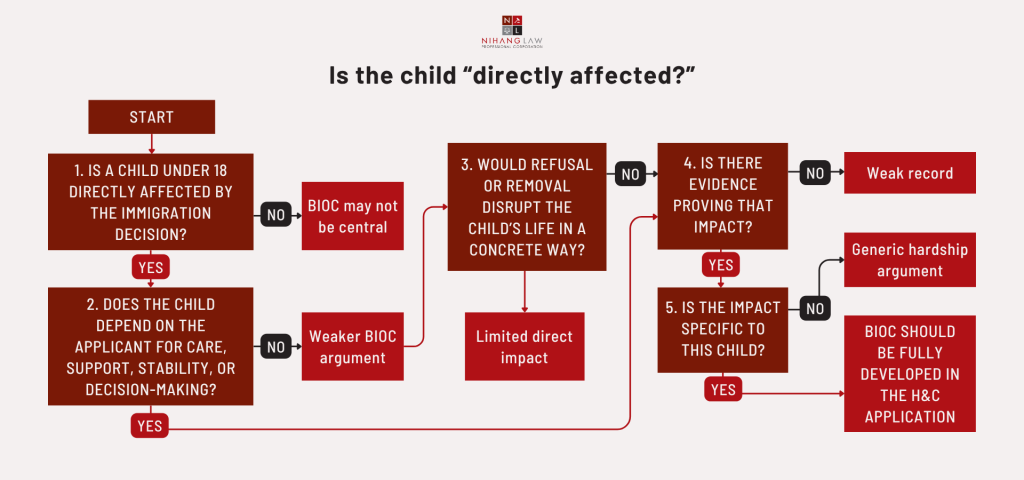
As the flowchart shows, simply stating “I have a child in Canada” is a weak argument. The critical question an officer must ask is: What exactly changes for this child if the application is refused or the parent is removed? IRCC’s guide specifically directs applicants to provide detailed information and documents that prove how a refusal could affect the child.
Area of Dependence | Weak Claim (Label Only) | Strong Claim (Direct Impact) |
Daily & Emotional Care | “I am the child’s parent/guardian.” | Detailed caregiving schedules showing the applicant’s exact role in the child’s daily routine and emotional stability. |
Financial Support | “I provide for the child.” | Financial records, rent receipts, and receipts for specific child-related expenses demonstrating reliance. |
School & Medical | “I take them to school/appointments.” | Letters from teachers or pediatricians identifying the applicant as the primary decision-maker or point of contact. |
Housing & Safety | “We live together.” | Evidence showing that removing the applicant would physically or financially destabilize the child’s living situation. |
Bypassing the 12-Month Bar
Proving a child is “directly affected” is legally critical for applicants facing the 12-month bar on H&C applications (which typically applies after a negative refugee decision). Under the Act and IRCC guidance, an applicant may be exempted from this bar if there is sufficient, credible, and objective evidence that removal would directly and adversely affect a child under 18. This elevates the phrase “directly affected” from a simple slogan to an outcome-changing legal threshold at the eligibility stage.
What Factors Do Officers and Reviewing Courts Usually Weigh Most?
The BIOC analysis is not a simple checklist where one specific document wins the case. It is an individualized and cumulative assessment. The recurring factors that decision-makers weigh most heavily include stability, caregiving, education, health, establishment in Canada, country conditions affecting the child, and the child’s specific needs at their current stage of development.
IRCC’s Core Factors
IRCC’s published guidelines explicitly direct officers to evaluate several child-focused elements:
- Age and developmental stage
- Degree of establishment in Canada
- Conditions in the country of origin that may affect the child
- Medical and health needs
- Educational progress and stability
- Gender-specific impacts
The Kanthasamy Standard: Context Over Checklists
Circling back to the Supreme Court of Canada’s decision in Kanthasamy v. Canada, this landmark ruling adds a deeper layer to the analysis: the principle that a child’s best interests are highly contextual.
They must be assessed through the child’s own lived circumstances, rather than through abstract and generalized assumptions. Legally, an officer cannot reduce the BIOC inquiry to a bare, dismissive conclusion that a child is young and can simply “adapt” to a new country.
The Real Question: Meaningful Engagement
When reviewing a refusal, courts are essentially asking whether the officer’s reasons demonstrate a real, meaningful engagement with the child’s reality. Reviewing judges look for answers to three critical questions:
- Did the decision-maker identify the child’s situation correctly?
- Did they actively connect the provided evidence to the child’s welfare?
- Did they weigh the child’s interests in a serious way, even if those interests did not ultimately dictate the final result?
The Vavilov Reasonableness Standard
Following the Vavilov decision, a “reasonableness review” looks at whether the H&C refusal makes sense in light of both the law and the facts. The court will strike down a decision if the officer failed to meaningfully grapple with the central issues and evidence raised by the applicant.
BIOC Issue | What Usually Helps | What Usually Weakens The Record |
School stability | Report cards, attendance, teacher letters, special program evidence | Generic claim that the child “likes school” |
Health or disability | Doctor letters, treatment plan, medication history, therapy records | Vague references to stress without diagnosis or context |
Emotional dependence | Counsellor evidence, caregiving schedule, affidavits with specifics | Formulaic family letters |
Establishment in Canada | Years in Canada, activities, friendships, language, community links | No timeline or supporting documents |
Country impact | Specific evidence on the child’s return situation | General country fears framed like a refugee claim |
Day-to-day care | Proof of who actually handles meals, transport, appointments, schooling | No evidence tying the parent to daily care |
The themes in this table track IRCC’s published BIOC factors and the Supreme Court’s contextual approach in H&C cases.
Nihang Law Insight
In many weak H&C files, the child is described as an attachment to the parent’s hardship story. In stronger files, the child has their own evidentiary record: school, health, routine, dependency, and future disruption. That shift usually makes the BIOC argument far more credible.
Although the immigration-law analysis of the best interests of the child is different from the family law test used in parenting disputes, both areas depend heavily on specific evidence about the child’s real circumstances.
What Evidence Usually Makes a BIOC Case Stronger?
Strong BIOC evidence must be concrete, current, child-specific, and tied to real consequences. IRCC officers are consistently more persuaded by records from neutral professionals and detailed timelines than by generalized emotional statements from the applicants alone.
The Practical Evidence Package
For Ontario families, building a strong case means documenting the child’s actual daily life. The goal is quality and relevance, not just volume. A comprehensive package typically includes:
- Educational Records: School letters, report cards, and attendance logs.
- Medical & Mental Health: Family doctor letters and, where appropriate, psychological or therapy records.
- Routine & Community: Caregiving schedules, financial records showing support, and proof of extracurricular or community involvement.
- Personal Statements: Detailed affidavits explaining the child’s exact daily dependence on the applicant.
The Strategic Goal: Proving Disruption
The core objective of this evidence is to prove disruption, not just the existence of a relationship.
Section 25(1.3) of the Immigration and Refugee Protection Act bars officers from using the H&C process to decide classic refugee-risk issues. Your evidence must clearly frame the situation as a hardship and child-welfare analysis, rather than a disguised refugee protection claim.
Handling Complex or High-Needs Cases
If a child has special needs, a history of trauma, developmental delays, behavioural support requirements, or a fragile caregiving arrangement, a parent’s affidavit is rarely enough.
- The Role of Professionals: In these cases, professional letters that explain the child’s need for continuity, routine, and the specific consequences of disruption carry massive weight because they translate general hardship into a child-specific impact.
- Court Scrutiny: When a refusal goes to judicial review, the Federal Court will look very closely at whether the IRCC officer meaningfully engaged with this specific type of central, professional evidence.
What Does the Roadmap Look Like in an Ontario H&C Case?
A sound Ontario H&C strategy requires proactive planning. It generally starts with screening for legal bars, building a child-centred evidentiary record, filing a coherent application, protecting temporary status where possible, and preparing early for the possibility of judicial review if the refusal reasons are legally weak.
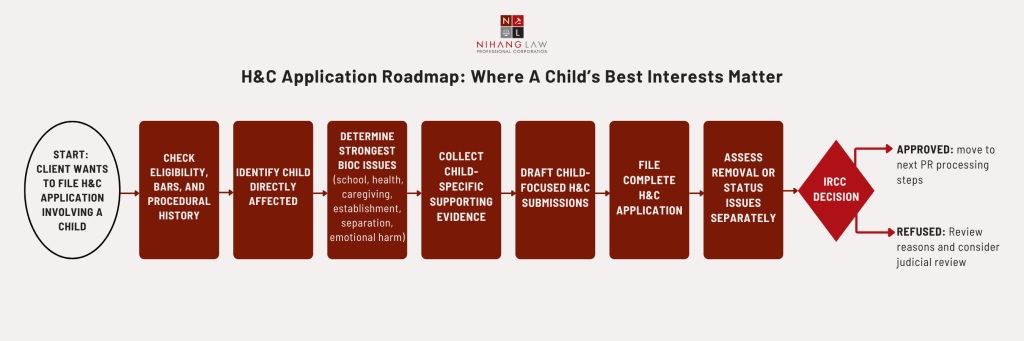
A practical roadmap often looks like this:
1. Screen eligibility first.
Confirm there is no pending refugee claim, no duplicate H&C application, and no statutory bar that blocks examination. If there was a recent refugee refusal, assess whether the child-based exception to the 12-month bar may apply.
2. Define the child’s theory of the case.
Decide whether the BIOC argument is mainly about school stability, health, primary caregiving, family separation, establishment, or some combination.
3. Build the record around that theory.
Collect specific documents, not just supportive letters. Affidavits should explain routines, dependence, and likely disruption in a detailed timeline.
4. File a coherent H&C package.
The application should clearly identify the exemptions requested and explain why compelling reasons justify relief from within Canada.
5. Plan status and enforcement risk separately.
An H&C application does not itself stop removal. If there is a removal issue, that requires separate procedural planning.
6. Prepare for time.
IRCC has said the H&C and Other category has no service standard, and current official committee materials report historical in-Canada H&C processing times of about 26.5 months for the rest of Canada, with wait times expected to grow. As of August 31, 2025, IRCC reported about 65,700 persons in inventory in in-Canada H&C and 1,200 admissions that year to date.
Nihang Law Insight
Many H&C files are treated too late as “forms plus sympathy.” The better approach is litigation-minded from the start: build the record so that, if refusal happens, the reasons can be tested against a clean, organized, child-focused evidentiary package.
What Happens If the H&C Application Is Refused?
Unlike some immigration pathways, there is no ordinary right to appeal a refused Humanitarian and Compassionate (H&C) permanent residence application. You cannot simply ask a tribunal to reweigh the facts of your case.
The Legal Remedy: Judicial Review
The primary legal recourse for a refusal is to file an application for “leave and judicial review” in the Federal Court. The deadlines to file are strict and move quickly:
- 15 days for a matter arising within Canada.
- 60 days for a matter arising outside of Canada.
Applicants must treat these timelines seriously and have the refusal reasons reviewed by legal counsel immediately upon receipt.
The Standard of Review: Reasonableness
Following the Supreme Court’s Vavilov decision, the reviewing court does not decide if they agree with the refusal. Instead, they ask whether the decision is “reasonable” in light of the legal framework and the evidence submitted.
Assessing BIOC on Judicial Review
In cases involving the Best Interests of a Child (BIOC), the court will closely examine how the IRCC officer handled the evidence. To be considered reasonable, the officer must have:
- Genuinely engaged with the child’s specific circumstances.
- Clearly explained the weight given to the BIOC evidence.
- Avoided conclusory reasoning (e.g., simply stating a child will “adapt” without explaining how or why based on the evidence).
The Outcome of a “Win”
A successful judicial review does not mean the Federal Court grants the H&C application itself. The court’s focus is strictly on whether the refusal can stand in law. If it cannot, the court will typically set aside the refusal and order that the application be re-determined by a different IRCC officer.
What Are The Most Common Mistakes in BIOC-Based H&C Files?
The most common mistakes are overgeneralizing the child’s hardship, under-documenting the child’s daily reality, confusing H&C with a refugee-risk claim, and waiting too long to react to a refusal. These errors often make an otherwise sympathetic file legally weak.
Common mistakes include:
- Treating the child as a background fact instead of building a separate child-centered evidentiary record.
- Relying only on emotional letters without school, medical, counselling, or caregiving proof.
- Saying a child will be “affected” without explaining how, when, and in what concrete way.
- Framing country concerns mainly as persecution or protection risk when section 25(1.3) limits that analysis in in-Canada H&C cases.
- Assuming a Canadian-born child guarantees success.
- Believing that filing H&C stops removal automatically.
- Missing the Federal Court deadline after refusal.
Frequently Asked Questions
Does having a Canadian-born child guarantee H&C approval?
No. A child’s best interests can materially strengthen an H&C case, but the law does not make BIOC automatically determinative. Officers still weigh the full record, and IRCC’s own guide says BIOC is one important factor among others.
Can a child outside Canada still matter in an H&C application?
Yes. IRCC’s H&C guide specifically says applicants must explain how children inside or outside Canada would be affected. The key issue is not geography alone; it is whether the child is directly affected and whether the evidence proves that impact.
Can BIOC help if my refugee claim was recently refused?
Sometimes. The Act and IRCC guidance recognize an exception to the 12-month bar where removal would adversely affect a directly affected child under 18. That does not guarantee success on the merits, but it can matter at the threshold stage.
Does filing H&C stop removal from Canada?
No. IRCC states that applying on H&C grounds does not prevent or delay removal. If there is an active enforcement or removal issue, that must be addressed separately and urgently with proper legal advice.
What kind of child evidence is usually strongest?
Evidence is usually strongest when it is current, neutral, and specific: school records, doctor or therapist letters, treatment or support plans, caregiving evidence, and affidavits that explain routines and likely disruption in concrete detail.
Do officers have to look at the case from the child’s perspective?
They must meaningfully assess the child’s interests in a contextual way. Supreme Court authority says the inquiry is highly contextual and that children’s interests must be treated as important, given substantial weight, and approached with real sensitivity.
What does the Federal Court usually look for in a BIOC refusal?
The Court usually asks whether the decision was reasonable and whether the reasons actually addressed the central child-related evidence and legal framework. It does not simply reweigh the facts because it would have preferred a different result.
Is school disruption alone enough for H&C?
Not always. School disruption can be important, especially for established children, but stronger files usually connect school evidence to broader stability issues such as caregiving, mental health, language, community integration, or special educational needs.
Key Takeaways
Evidence Over Emotion
The best interests of the child are not just a decorative paragraph in an H&C application—they are a mandatory, statutory part of the legal analysis. The strongest BIOC cases are rarely the loudest or most emotional. They succeed by proving, through concrete, child-specific evidence, exactly what a refusal or removal would do to a real child’s life.
The Ontario Strategy
Building a successful application requires careful screening for legal bars, disciplined evidence gathering, and structuring your evidentiary record from day one with the possibility of Federal Court review in mind.
Important Legal Reminder: No article can predict an H&C outcome. These applications are highly discretionary, fact-sensitive, and heavily influenced by procedural history, credibility concerns, and the quality of the evidence filed. If you are dealing with removal risk, a recent refugee refusal, or a child with urgent health or schooling needs, it is critical to get file-specific advice quickly.
How Nihang Law Can Help
Navigating an H&C application is complex, and the stakes for your family are high. Our immigration team can help you:
Assess whether a BIOC argument is truly central to your overall H&C strategy.
Identify and fill the critical evidence gaps that actually matter to an officer.
Review refusal reasons for potential judicial review, especially when tight Federal Court deadlines are running.
Sources & References
- Immigration and Refugee Protection Act, SC 2001, c 27, s 25
- Guide 5291: Humanitarian and Compassionate Considerations
- Humanitarian and Compassionate Grounds
- Apply to the Federal Court of Canada for Judicial Review
- How to File an Application for Leave and for Judicial Review (Immigration)
- CIMM – Humanitarian and Compassionate (H&C) and Other Immigration – October 21, 2025
- Kanthasamy v Canada (Citizenship and Immigration)
- Canada (Minister of Citizenship and Immigration) v Vavilov
- Mason v Canada (Citizenship and Immigration)
Thank you for reading this post, don't forget to subscribe!