


1st April 2026BY Nihang Law
Received a Bill C-12 Ineligibility Letter About Your Asylum Claim? What to Do Next
If you receive a Bill C-12-related letter, your immediate priority is clear: do not ignore it and do not guess at dates from memory.
Bill C-12 is now law. IRCC states that the new eligibility rules apply to asylum claims made on or after June 3, 2025. Under these rules, your claim may now be found ineligible if it was made:
- More than one year after your first entry into Canada following June 24, 2020.
- More than 14 days after entering between ports of entry along the Canada–U.S. land border.
If your claim is found ineligible, it does not go to the IRB. Instead, IRCC will refer you to CBSA for removal, and CBSA will officially inform you whether you may apply for a Pre-Removal Risk Assessment (PRRA).
Last Updated: April 2026
Receiving a letter from IRCC can be nerve-wracking, especially when it raises concerns about your asylum claim. If the letter says your claim may be ineligible under Bill C-12, it is important to act carefully and quickly. These letters may focus on your first entry into Canada, the timing of your claim, or whether you entered from the United States between ports of entry.
In some files, IRCC may be asking for information before making a final decision. In others, the claim may already be moving away from the IRB process and toward CBSA and possible PRRA steps. The first step is to identify what kind of letter you received, confirm the relevant dates, and respond with records rather than assumptions.
Legal Disclaimer: This article provides general legal information for Ontario readers. It is not legal advice and does not create a lawyer-client relationship. Outcomes may depend on the exact wording of the letter, your first entry date, your claim date, prior proceedings, inadmissibility issues, and any Canada–U.S. border facts.
Quick Start: What to Do Based on the Letter You Received
My letter asks for dates, documents, or submissions before a decision is made
Start by calendaring the deadline, reading the request carefully, and gathering proof of your first entry, later travel, and claim date before responding.
My letter says the claim may be ineligible because I waited too long after entering Canada
Start by confirming your first entry into Canada after June 24, 2020, checking whether the officer used the correct date, and collecting records that support your timeline.
My letter mentions the United States, an irregular crossing, or a 14-day issue
Start by identifying exactly where you entered Canada, when you entered, and when the claim was made, because the route and timing may determine whether the issue is STCA-related, Bill C-12-related, or both.
CBSA has contacted me about removal or PRRA
Start by reviewing the letter immediately, checking whether you have been told you may apply for PRRA, and assessing next steps without delay.
I need to keep working while this is being sorted out
Start by checking your current permit status, preserving proof of your work authorization, and reviewing whether a work permit option may still be available while the file moves forward.
What Kind of Bill C-12 Letter Might You Receive?
The most critical step upon receiving a Bill C-12 letter is to identify whether the letter is preliminary, final, or already tied to removal-stage consequences. Rather than focusing on what the document is called, determine immediately if the government is asking for a response before a decision or notifying you that a decision has already been made.
Understanding the Process: Eligible vs. Ineligible Claims
Not every Bill C-12-related letter will look the same. Some request information before a final determination, while others explicitly state that your claim is ineligible, triggering a referral to the Canada Border Services Agency (CBSA) and possible Pre-Removal Risk Assessment (PRRA) steps.
IRCC’s public guidelines explain the end points clearly:
- Eligible claims are sent to the Immigration and Refugee Board (IRB).
- Ineligible claims are referred to CBSA for removal.
- CBSA notifies the individual whether they may apply for a PRRA.
Keep in mind that the public work-permit policy assumes some individuals will have their claims “determined to be ineligible” before their PRRA notification even arrives.
Identifying Your Letter and Immediate Next Steps
Use the table below to determine what type of letter you have received and what your immediate actions should be:
What The Letter Seems to Be | What It Usually Means | Immediate Priority |
It asks for dates, documents, or submissions | The officer may still be assessing eligibility facts | Calendar the deadline and build a document-backed timeline |
It says the claim is ineligible under the one-year rule | The file may no longer be headed to the IRB | Verify your first entry after June 24, 2020 and the exact claim date |
It mentions U.S. entry or a 14-day issue | Border-route facts may control eligibility | Confirm where you entered and when the claim was made |
It comes from CBSA and mentions removal or PRRA | The matter may already be in the removal-stage protection track | Review PRRA, work-permit, and immediate compliance issues |
Legal Perspective
In practice, many people lose time by arguing with the label on the letter instead of identifying the legal stage. The better first move is to ask: Is this inviting my response, or is this telling me what has already happened?
What Should You Check First in the Letter?
The most important practical action step at this stage is to avoid responding too fast with estimated dates or informal explanations. Take the time to verify your facts, and if the letter requests documents, treat the request as mandatory unless your lawyer advises otherwise. Rushing your response is a critical file-management mistake; taking the time to review the details properly is often where a case either stabilizes or deteriorates.
Five Core Elements to Identify
Start by reviewing the document to find these five critical pieces of information:
- The deadline for any required response.
- The sender of the letter.
- Whether the letter is preliminary or final.
- Which Bill C-12 rule is being raised?
- Which dates the officer appears to be relying on.
Read Line by Line and Mark Key Details
Go through the text meticulously and highlight the following factors:
- Who sent it and what authority is mentioned.
- Whether it asks for a response or explicitly says “ineligible.”
- Whether it refers to a first entry or a U.S. border entry.
- Whether it requests proof.
Verify Your Documents Before Responding
Never rely on estimates or memory. Before you submit any explanations or finalize your response, you must verify your timeline by checking your official records, such as your passport, visitor records, permit history, airline records, and prior submissions.
Why Do First-Entry Date and Claim Date Matter So Much?
If your letter questions your entry dates, your immediate priority must be reconstructing your exact legal timeline using official records, rather than just providing a written narrative. This is because Bill C-12 calculates your one-year eligibility deadline based on your first entry into Canada, not your most recent arrival.
Understanding the One-Year Rule
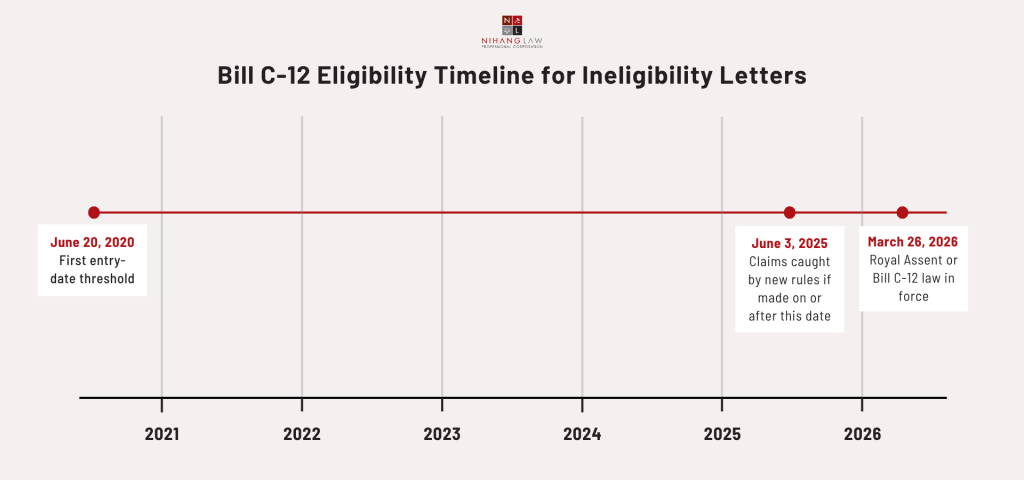
Under Bill C-12, asylum claims made on or after June 3, 2025, may be deemed ineligible if they are filed more than one year after your first entry into Canada following June 24, 2020.
This specific rule is the heart of many new Bill C-12 letters. A common mistake is assuming that a recent re-entry date resets the clock. However, IRCC’s public guidance is strict: the one-year analysis looks entirely at that first entry, even if you later left Canada and returned. For many Ontario workers, students, and visitors, the initial dispute isn’t about the merits of their refugee claim yet, but about proving this precise timeline to the government.
How to Build a Strong First Response
If the officer’s letter appears to rely on the wrong date, your response must be built around hard evidence. A strong reply usually includes a clean, document-backed chronology detailing the following:
- Your first entry into Canada (after June 24, 2020).
- Any later exits and re-entries.
- Your complete status history (such as work or study permits).
- The exact date your asylum claim was officially made.
What If the Letter Is About a U.S. Border Entry?
If your letter mentions the United States, do not assume it is automatically a standard Safe Third Country Agreement (STCA) case. Your immediate priority is to verify your exact entry route and exact claim timing, because Bill C-12 now makes your claim ineligible if you entered Canada irregularly and waited more than 14 days to file.
Understanding the Two Different Border Problems
People often mix up these two distinct issues. It is crucial to understand the difference between the existing STCA framework and the newly added Bill C-12 rules:
- The STCA Rules: These older, still-active rules cover claims made at official land ports of entry, as well as claims made within 14 days after an irregular entry from the U.S. (unless an exception or exemption applies).
- The Bill C-12 Rules: This introduces a different problem. Claims made more than 14 days after entering between ports of entry along the Canada–U.S. land border will not be referred to the Immigration and Refugee Board (IRB).
Do STCA Exceptions Still Matter?
The STCA exceptions still matter in the right case. Canada’s official STCA page continues to list several standard exceptions, including:
- Family-member exceptions
- Unaccompanied-minor exceptions
- Document-holder exceptions
- Public-interest exceptions
However, remember this crucial warning: these exceptions do not answer every Bill C-12 timing problem. To be effective, they must be matched carefully to your specific route of entry and the current stage of your file.
Nihang Law Insight
A common mistake is to treat any U.S.-related letter as a border-exception problem. Sometimes it is. Sometimes it is actually a 14-day timing problem under Bill C-12. The response strategy may be very different.
Why Is This Issue Showing Up So Quickly in Ontario?
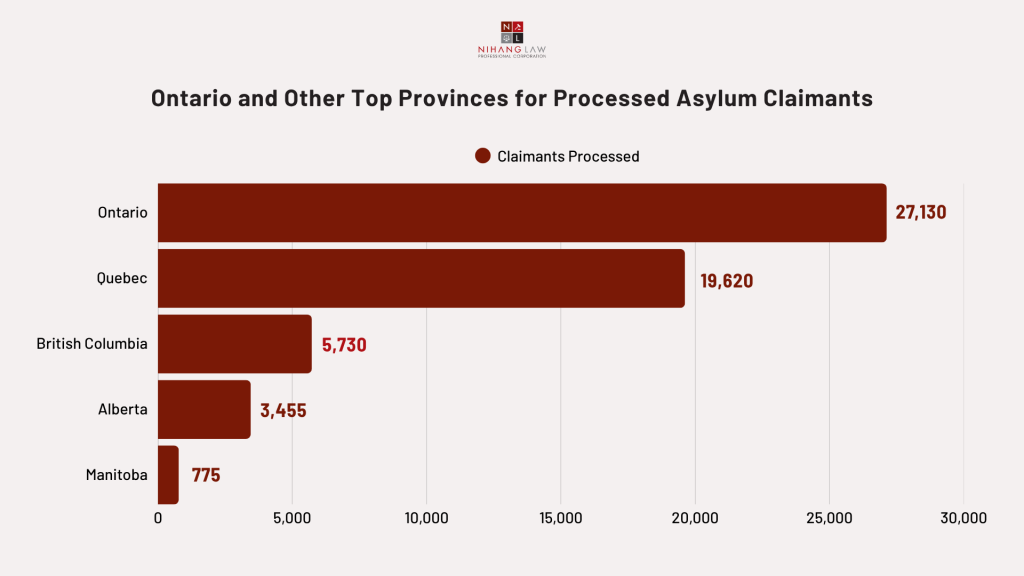
The surge of Bill C-12 letters in Ontario is driven by two main factors: the retroactive application of the new rules (which apply to claims made on or after June 3, 2025, even though the bill took effect on March 26, 2026) and the fact that Ontario processes the highest volume of asylum claimants in the country.
The Volume of Claims: Ontario vs. Other Provinces
Between January and June 2025, Ontario processed significantly more asylum claimants through CBSA and IRCC combined than any other province. While these numbers do not predict exactly how many Bill C-12 letters will be sent, they clearly show why this must be treated as a broad practical issue in Ontario rather than a rare edge case:
The Operational Backdrop: Severe IRB Backlogs
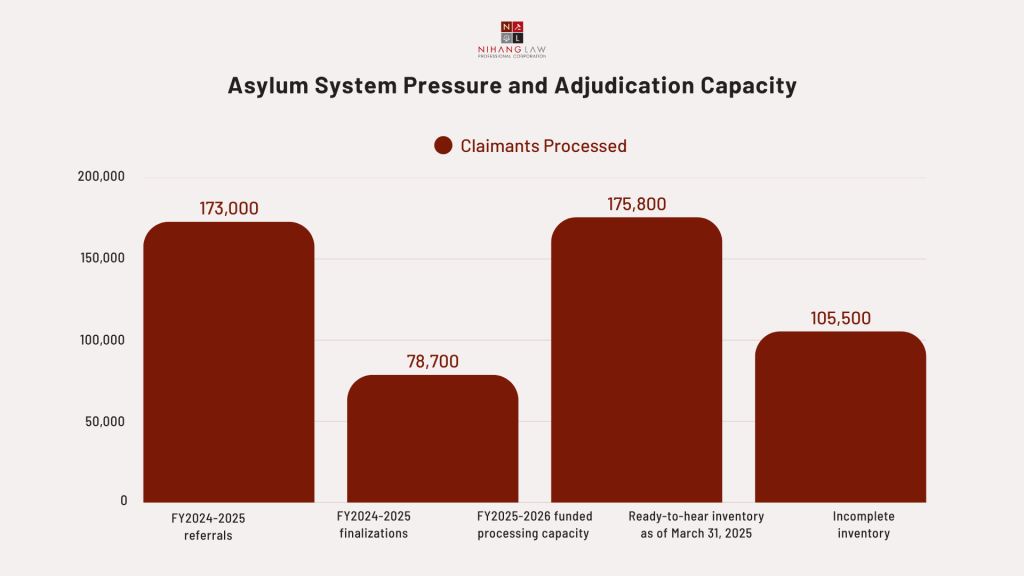
This rapid enforcement is also happening against a backdrop of intense pressure on the Immigration and Refugee Board (IRB). Whether you agree with the government’s policy choices or not, the operational reality driving these new eligibility letters is staggering. Looking at the IRB’s caseload for the 2024–2025 fiscal year:
What Happens If The Claim Is Found Ineligible?
If your claim is found ineligible, it will not be referred to the IRB for a refugee hearing. Instead, IRCC will refer you to CBSA for removal from Canada, and CBSA will notify you whether you may apply for a Pre-Removal Risk Assessment (PRRA). It is crucial to understand that a PRRA is a different protection process, not a substitute IRB hearing.
Understanding the Shift to Removal and PRRA
Many people misunderstand this critical shift in their legal posture. A claim that never reaches the IRB is not simply “delayed”—it means you will need to leave Canada.
When CBSA starts the removal process, an officer will check if you meet the criteria for a PRRA. Keep this strict rule in mind: you can only apply for a PRRA if a CBSA officer explicitly tells you that you are eligible.
Work Permit Protections During Delays
There is one important practical protection available. IRCC created a temporary public policy—effective the day Bill C-12 received Royal Assent—to help manage the gap between an ineligibility finding and a PRRA notification. This policy:
- Facilitates access to open work permits for certain individuals whose claims are ineligible for the IRB.
- Allows certain existing work permits to avoid automatic cancellation when a removal order becomes enforceable.
How This Differs From a Refused Claim
By contrast, when a refugee claim is refused after being heard by the IRB, the focus usually shifts to appeals and other post-refusal options. In those cases, the central issue is often whether the decision itself was legally unreasonable or procedurally unfair, rather than whether the person can simply start a new legal process.
How Should You Prepare A Response Or Submission Package?
The most effective response is not an abstract argument, but a factual correction. Your primary goal is to show why the officer’s chronology, entry-route analysis, or assumptions may be incomplete or wrong, building your case strictly around verified dates, travel records, permit history, and the exact wording of the letter.
What to Include in Your Response Package
A practical submission package must provide undeniable proof of your timeline. To establish exactly where and when your entry occurred, you should often include:
- Passports and all entry stamps
- Airline itineraries
- Visitor records and work or study permits
- Prior IRCC correspondence
- Confirmation of the claim date
- Any CBSA or U.S.-border records ### Tailoring Your Strategy to the Issue
How you organize this proof depends on what the government is questioning. If the letter invites submissions, answer what was asked directly and attach concrete proof for each material date.
If the file turns on your first entry, create a clean, one-page chronology. If it turns on a U.S. crossing, create a detailed route-and-date summary.
Nihang Law Insight
In many Bill C-12 letter files, the first legal fight is not yet about persecution evidence. It is about the timeline. Clients are often surprised by how much turns on proving the right date, the right route, and the right status history.
What Are The Next Practical Steps After You Receive A Bill C-12 Letter?
Move quickly but methodically. The most important takeaway is that delay usually reduces options; organized evidence usually improves them. You must immediately identify the stage of the file, reconstruct the timeline, gather your records, and assess whether the core issue is first-entry timing, U.S. border timing, PRRA, work permits, or a later court challenge.
To effectively manage your response and protect your claim, follow these critical steps:
Read the letter twice and identify the stage.
- Is it asking for a response, or stating that the claim is already ineligible?
Calendar the deadline immediately.
- Build your schedule backwards so you have enough time to gather records before drafting your response.
Create a date chart.
- Include your first entry after June 24, 2020, all later re-entries, and the exact claim date.
Collect documentary proof.
- Passports, permits, visitor records, airline records, CBSA and IRCC correspondence, and any U.S.-border paperwork may matter.
Check the specific timing issue.
- Determine whether the issue is first-entry timing or U.S. irregular-entry timing. They are different rules with different factual triggers.
Review PRRA and work-permit consequences early.
- Ineligibility may move the file out of the IRB stream and into a removal/PRRA/work-permit strategy.
Do not travel or make status decisions casually.
- Once CBSA involvement begins, practical risk management matters more, not less.
What Common Mistakes Should You Avoid?
The most critical takeaway is that avoiding common mistakes—like delay or sloppy date reconstruction—prevents a manageable file from turning into a much harder one. The most frequent errors involve confusing timelines or misunderstanding the different legal processes involved.
To protect your claim, ensure you do not make any of the following missteps:
- Responding emotionally before checking your official records.
- Using the most recent entry date instead of your first post–June 24, 2020 entry.
- Assuming a departure and return to Canada resets the one-year clock.
- Treating every U.S.-related letter as an STCA-exception case.
- Ignoring the difference between an IRB referral and a PRRA.
- Waiting to think about work permits until after CBSA contact.
- Assuming there is no remedy simply because the letter sounds final.
Frequently Asked Questions
Is every Bill C-12 letter a true procedural fairness letter?
Not necessarily. IRCC’s public pages currently describe ineligibility determinations, referrals to CBSA, PRRA access, and work-permit relief without publishing a specific page labeled as a “Bill C-12 PFL.” However, in practice, if the letter invites your response before a final decision, it should be treated with the strict urgency of a fairness-stage process.
What if the letter seems to use the wrong entry date?
This may be the most important issue in your file. Bill C-12’s one-year rule turns entirely on your first entry into Canada after June 24, 2020. The safest and most effective response is a document-backed chronology, rather than a memory-based explanation.
Does leaving and returning to Canada reset the one-year clock?
No. IRCC’s public guidance confirms that the one-year rule applies based on your first entry after June 24, 2020, even if you later left and returned. This strict interpretation is why your complete travel history must be reconstructed carefully.
What if my letter mentions the United States?
You must immediately determine whether the issue is a Bill C-12 timing problem, an STCA problem, or both. The rules apply differently based on your timeline:
- Under the new Bill C-12 rule: Claims made more than 14 days after an irregular entry from the U.S. are ineligible for IRB referral.
- Under the STCA: Claims made at land ports of entry, or within 14 days after an irregular entry, may still lead to a return to the U.S. unless a specific exception applies.
Will I still get a refugee hearing if the claim is found ineligible?
No. If your claim is ineligible, IRCC states it will not be referred to the IRB. Instead, you will be referred to CBSA for removal, and CBSA will inform you whether you may apply for a Pre-Removal Risk Assessment (PRRA). This is a completely different process with a different legal posture.
Can I still work if my claim is found ineligible?
Possibly. IRCC created a temporary public policy (effective March 26, 2026) to facilitate open work permits for certain foreign nationals whose claims are ineligible for the IRB. It also allows certain existing work permits to avoid automatic cancellation when a removal order becomes enforceable.
Does PRRA start automatically?
No. You can only apply for a PRRA if a CBSA officer explicitly tells you that you are eligible. When CBSA initiates the removal process, an officer checks your eligibility. This means the timing of a PRRA depends entirely on government removal-stage steps, not on your own decision to file.
Can a negative decision still be challenged later?
Possibly, but the answer depends heavily on who made the decision and at what stage. Canada’s Federal Court confirms that immigration decisions can be reviewed, but there are strict deadlines to seek review. The correct legal route must be assessed carefully and quickly for your specific file.
Key Takeaways
Bill C-12 is no longer a future problem. It is now law, and it is already changing how some asylum files are screened before they ever reach the IRB. For many Ontario readers, the urgent question is not whether the refugee story is strong. It is whether the file is being stopped earlier because of first-entry timing, U.S. border timing, or the way the timeline is being read by the officer.
Reminder: Bill C-12 is now in force, but the legal result may still turn on the specific facts of the case. General summaries are not enough where claim dates, first entry into Canada, previous claims, inadmissibility, or U.S. border-entry facts may affect eligibility or next steps.
How Nihang Law Can Help
If you received a Bill C-12-related letter in Ontario, Nihang Law’s immigration team can help assess the letter, verify the relevant dates, organize the response record, and advise on the next practical step—whether that means responding before a final determination, preparing for PRRA-related consequences, protecting work authorization, or reviewing whether a later challenge may be available.
Sources and References
- C-12 (45-1) – LEGISinfo – Parliament of Canada
- New immigration and asylum measures from Bill C-12 (the Strengthening Canada’s Immigration System and Borders Act) have become law – Canada.ca
- Claiming asylum from within Canada: Meet the requirements to submit an asylum claim – Canada.ca
- Temporary public policy to facilitate access to open work permits for certain foreign nationals, in Canada, whose claims for refugee protection are ineligible to be referred to IRB – Canada.ca
- Pre-removal risk assessment: Who can apply – Canada.ca
- Canada-U.S. Safe Third Country Agreement – Canada.ca
- Immigration and Refugee Protection Regulations – section 159.4
- Immigration and Refugee Board of Canada Main Estimates (2025–2026) – Canada.ca
- Asylum claimants by year – January to June 2025 – Canada.ca
- Apply to the Federal Court of Canada for judicial review – Canada.ca
Thank you for reading this post, don't forget to subscribe!