



9th March 2026BY Qasim Nihang
What To Do When a Parent Refuses to Sign a Child Passport Application in Ontario
Last Updated: March 2026
For a Canadian child under 16, the passport application usually requires all parents or legal guardians to sign, and the application must also include any legal documents dealing with custody, decision-making, parenting time, mobility, or passports. If the other parent will not sign, the issue often shifts to Ontario family court, where the judge focuses on the child’s best interests rather than the parents’ conflict.
Ontario courts may make interim or final parenting orders, including orders about decision-making, travel, and related passport issues. A travel consent letter is helpful for border and airline purposes, but it does not replace a needed court order.
A refused signature can derail a trip faster than most parents expect. School breaks, family emergencies, weddings, funerals, and pre-booked travel can all turn into legal stress when the other parent says “no” to a child passport application or refuses to sign a travel consent letter. Many parents assume the passport office will sort it out. Usually, it will not.
For children under 16, Passport Canada expects signatures from all parents or legal guardians and wants to see any court orders or agreements that affect custody, decision-making, parenting time, mobility, or passports. If there is conflict, the real question becomes whether the refusal is justified and what order the Ontario court should make in the child’s best interests. Acting early matters, because urgent travel and incomplete family orders often create avoidable problems.
Disclaimer: This article is general information for Ontario readers, not legal advice. Family law outcomes depend on the wording of your order or agreement, the travel details, safety concerns, and your child’s best interests. Passport and border requirements can also change.
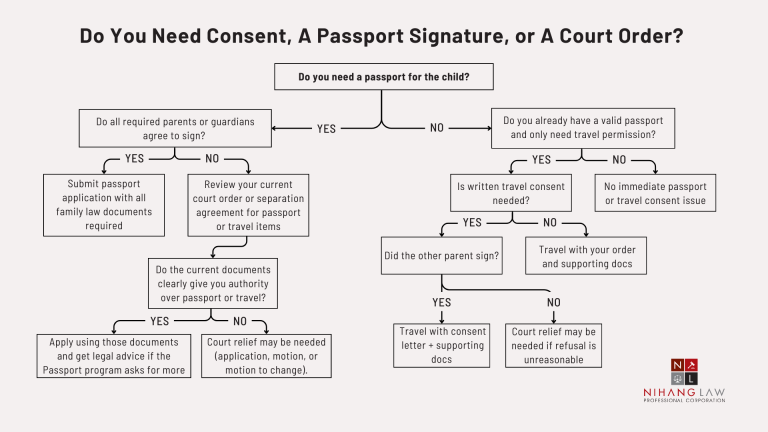
Quick Start: Pick Your Path
You need a child passport now:
- Check your current court order or separation agreement, gather all parenting documents, and confirm whether the other parent has actually refused or is simply non-responsive.
You already have a passport but need travel consent:
- Prepare a detailed consent request with dates, destination, flights, accommodation, contact information, and return plan. Border officials may ask for written permission.
You have no clear parenting clause:
- Consider an Ontario application or motion for decision-making responsibility, travel terms, passport signing authority, or a specific travel order.
Travel is imminent or there is a removal risk:
- Urgent court relief may be available where there is immediate danger a child may be removed from Ontario.
When Does A Refusal Become A Legal Problem?
A refusal becomes a legal problem when the child cannot obtain a passport, cannot travel as planned, or the refusal conflicts with the child’s best interests, an existing order, or a separation agreement. At that point, the dispute usually requires family law analysis, not just administrative follow-up.
For child passports, Canada’s current guidance says all parents or legal guardians must sign the form, and if both cannot sign, the applicant should contact the Passport Program for direction. The application must also include all legal documents with valid clauses about custody, decision-making responsibilities, access, parenting time, mobility, and any clause specifically about the child’s passport.
That means a separated parent does not usually solve the problem by submitting an incomplete application and hoping it is accepted. The federal regime also says that where separated or divorced parents have a court order or separation agreement granting the non-custodial parent specific access rights, a passport cannot be issued unless the application includes evidence that issuing the passport is not contrary to those terms. If an order restricts the child’s movement to a judicial district, the order generally must be revoked or varied before travel outside Canada is allowed.
Nihang Law Insight
In practice, many passport disputes are not really about the passport. They are about trust, poor communication, unpaid support, or fear the child will not be returned. Courts tend to respond better when the travelling parent brings a specific, transparent plan rather than broad complaints that the other parent is being difficult. That approach aligns more closely with the best-interests framework.
What Does The Court Look At In Ontario?
Ontario courts do not decide these cases based on who feels more offended or more controlling. The court focuses on the child’s best interests, including safety, stability, the child’s needs, the parents’ ability to cooperate, and any relevant family violence, court orders, or safety concerns.
Under the Divorce Act, when the parents are or were married and divorce-related parenting orders are in issue, the court must consider only the child’s best interests and must give primary consideration to the child’s physical, emotional, and psychological safety, security, and well-being. Relevant factors include the child’s need for stability, the history of care, each parent’s willingness to support the child’s relationship with the other parent, communication and cooperation, and any relevant civil or criminal proceedings.
Ontario’s family law framework also recognizes decision-making responsibility as major decision-making about a child’s life and well-being. A court can make interim and final parenting orders and may include terms, conditions, restrictions, or provisions about relocation and other matters the court considers appropriate. That is the legal opening through which courts often address passports, travel consent, document signing, and return conditions.
A parent who refuses consent may have a legitimate concern, for example, a real non-return risk, unclear travel details, family violence, criminal proceedings, or a destination-specific safety issue. But a refusal with little explanation, shifting reasons, or no child-focused concern may be more vulnerable to challenge. In Ontario commentary and case discussion, courts have recognized that travel consent may be ordered or the need for consent may be dispensed with, depending on the circumstances and the wording of the existing order.
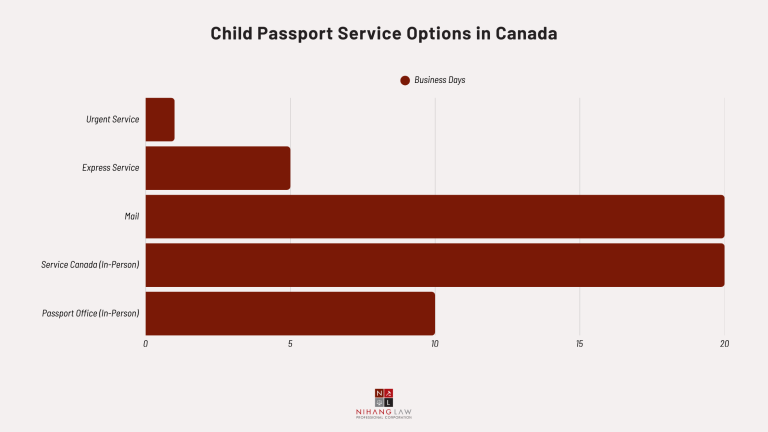
Figure 2: Child passport service options in Canada
Does A Travel Consent Letter Solve The Problem?
No. A travel consent letter helps with travel, but it does not replace a required passport signature, and it does not override a court order or separation agreement. It is a practical travel document, not a substitute for proper legal authority.
Global Affairs Canada recommends a consent letter whenever a child travels abroad alone, with only one parent, or with another adult. The letter should generally be signed by any parent or person with decision-making responsibility who is not travelling with the child. It is strongly recommended that an adult witness it, ideally a notary public. Still, the government also warns that the letter may not always be sufficient for foreign authorities and does not guarantee against abduction or non-return.
See travel consent letter guidance.
So, if your issue is only border friction, a careful consent letter plus the relevant parenting order may be enough. If the issue is that the other parent refuses to sign a child passport application, refuses travel consent, or relies on an order that restricts travel, you may need a court order instead.
What Court Options Are Available In Ontario?
Direct answer: Depending on the procedural posture, an Ontario parent may bring an application, a motion within an existing case, or a motion to change a final order, seeking interim or final terms about decision-making responsibility, passport signing, travel consent, passport possession, or specific travel dates and conditions.
If there is already a family case, a motion may be the fastest route for temporary relief. If there is a final order that no longer works, a motion to change may be necessary. Ontario’s court guides say Form 35.1 is required when a party claims decision-making responsibility, parenting time, or contact, whether in an application or in a motion to change.
See Ontario guide to starting a family case and see also Ontario guide to motions to change.
Where there is immediate danger that a child may be removed from Ontario, the Family Law Rules allow a case to be started and a motion to be heard in any municipality, with transfer afterward unless the court orders otherwise. That rule matters in urgent travel or abduction-risk scenarios.
Legal Perspective
Parents often ask for “sole custody for passport purposes only.” Modern orders do not always use older custody language, but the practical request can still be framed narrowly: a defined order giving one parent authority to apply for or renew the passport, hold the passport, sign travel paperwork, or take the child on a specified trip. Narrow relief is sometimes easier to justify than a broad restructuring of all parenting rights.
What Evidence Should You Bring If The Other Parent Is Refusing?
Bring evidence that shows the refusal, the travel plan, your parenting terms, and why the proposed trip or passport request is consistent with the child’s best interests. Specific documents usually matter more than emotional allegations.
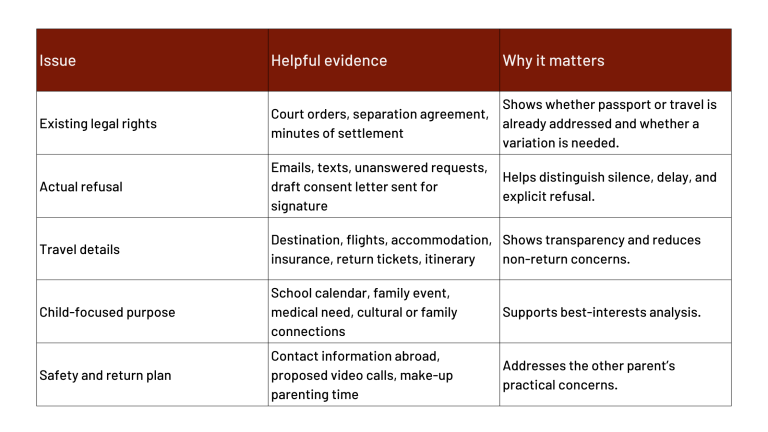
A well-prepared record also matters because Passport Canada may contact the other parent or guardian, and border officials may ask questions if the child is travelling without both parents.
See Canada child passport application page and see also travel consent letter guidance.
How Should You Proceed Step-by-Step?
Direct answer: Move in sequence: review the order, make a proper written request, gather evidence, assess urgency, and then choose the right court procedure. Parents often lose time by skipping the record-building stage.
Step-by-Step Roadmap
- Review the current order or agreement. Look for clauses on decision-making responsibility, travel, mobility, passport application, passport possession, and return conditions.
- Send a clear written request. Include destination, dates, flight details, lodging, emergency contacts, and when the child will return. Attach the consent letter or passport form and ask for a response by a reasonable deadline.
- Preserve the response. Keep texts, emails, and any reasons given for refusal. If the parent is non-responsive, document that too.
- Assess the legal route. If there is no case, start one. If there is an existing case, consider a motion. If there is a final order that needs revision, consider a motion to change.
- Prepare the required forms. If you are asking for decision-making responsibility or parenting-related relief, Form 35.1 is commonly required.
- Consider urgency carefully. If there is immediate danger the child may be removed from Ontario, special urgency rules may apply.
- Avoid booking around uncertainty. Current service standards vary by application type, and urgent or express service may require proof of need. The government also says not to finalize travel plans until the passport is received.
Nihang Law Insight
Where travel is genuine and time-sensitive, a parent’s evidence should read like a project plan, not a grievance letter. Judges usually want to know where the child is going, why, for how long, who will be there, how the child will come back, and how the other parent will stay informed.
What Mistakes Do Parents Commonly Make?
The biggest mistakes are acting informally, withholding information, or assuming the other parent’s refusal will look unreasonable without proof. Courts usually expect details, documentation, and child-focused reasoning.
- travelling without required consent or without checking the order
- applying for the passport without disclosing relevant family-law documents
- giving vague travel details and expecting immediate agreement
- waiting until the week before travel to raise the issue
- turning a child travel request into a fight about support or unrelated grievances
- ignoring real safety, family violence, or non-return concerns
- assuming a consent letter alone overrides an order or solves a passport-signature problem
Frequently Asked Questions
Can one parent apply for a child passport in Canada without the other?
Usually not for a child under 16. Canada’s guidance says all parents or legal guardians must sign, and if both cannot sign, the applicant should contact the Passport Program. Relevant court orders and agreements must also be included.
Does sole decision-making responsibility automatically fix everything?
Not always. A sole-decision-making clause may help, but border officials or airlines may still ask for a consent letter or court documents. The exact wording of the order still matters.
Can the court order the other parent to sign?
The court can make parenting orders and impose terms it considers appropriate, including practical travel and passport-related relief. Depending on the facts, the order may effectively require cooperation or dispense with the need for that parent’s consent.
What if the other parent is missing or impossible to reach?
Canada’s passport guidance says to contact the Passport Program if you do not know where the other parent is or cannot get their signature. For travel, the government also suggests carrying any relevant court order and getting legal advice where no order exists.
Can I bring an urgent motion before the trip?
Sometimes. Ontario’s Family Law Rules contain urgency language where there is immediate danger that a child may be removed from Ontario. Whether your case qualifies depends on the facts and the court’s assessment.
What if I just travel anyway?
That can create serious problems. A consent letter does not guarantee protection against abduction allegations or non-return concerns, and travelling contrary to an order may seriously harm your position in family court.
Does a notarized consent letter guarantee entry to another country?
No. Global Affairs Canada says a consent letter may not always be recognized by foreign immigration authorities, and different countries can impose their own requirements.
How long does a child passport take?
Current federal service standards in Canada generally show about 10 business days in person at a passport office, 20 business days by mail or at a Service Canada Centre, 2 to 9 business days for express service, and next-business-day service for urgent processing, subject to proof-of-need requirements and other conditions.
Closing Takeaway
When the other parent unreasonably refuses to sign a passport application or travel consent, the solution is rarely to argue harder. The real task is to line up the right documents, the right parenting terms, and the right evidence so the issue can be assessed through the child’s best interests.
In many Ontario cases, practical, narrow relief is available, but timing, wording, and proof matter. If your trip is approaching or your current order is unclear, speaking with family counsel early can prevent a routine travel plan from becoming a much larger dispute. Nihang Law can review your order, assess the safest procedure, and help you seek practical court relief where appropriate.
Reminder: Do not rely on a travel booking, a verbal agreement, or a generic consent form alone. Check the court order, confirm the passport requirements, and get legal advice where the other parent refuses, disappears, raises safety allegations, or where travel is imminent.
Sources & References
- Canada child passport application page: https://www.canada.ca/en/immigration-refugees-citizenship/services/canadian-passports/child-passport.html
- Canada passport help centre: https://www.canada.ca/en/immigration-refugees-citizenship/services/canadian-passports/help-centre/apply.html
- Canadian Passport Order: https://laws-lois.justice.gc.ca/eng/regulations/SI-81-86/
- Travel consent letter guidance: https://travel.gc.ca/travelling/children/consent-letter
- Travel documents for children: https://travel.gc.ca/travelling/children/children-travel
- Divorce Act, best interests of the child: https://laws-lois.justice.gc.ca/eng/acts/D-3.4/section-16.html
- Divorce Act, parenting orders: https://laws-lois.justice.gc.ca/eng/acts/D-3.4/section-16.1.html
- Ontario Family Law Rules: https://www.ontario.ca/laws/regulation/990114
- Ontario guide to starting a family case: https://www.ontario.ca/document/guide-procedures-family-court/steps-filing-application
- Ontario guide to motions in family court: https://www.ontario.ca/document/guide-procedures-family-court/motions-family-court
- Ontario guide to motions to change: https://www.ontario.ca/document/guide-procedures-family-court/steps-making-motion-change
- Ontario parenting-time and decision-making overview: https://www.ontario.ca/page/parenting-time-decision-making-responsibility-and-contact
- CanLII Connects summary discussing Yohannes v. Boni, 2020 ONSC 4756: https://canliiconnects.org/en/commentaries/71889
Thank you for reading this post, don't forget to subscribe!