




12th March 2026BY Nihang Law
Pre-Removal Risk Assessment (PRRA) vs. Refugee Claim in Canada: What Is the Difference Between Facing a Risk to Life and Seeking Asylum?
Last updated: March 2026
A “risk to life” argument does not automatically mean a person should wait for a Pre-Removal Risk Assessment (PRRA) instead of making a refugee claim. In Canada, a refugee claim can succeed either because the person is a Convention refugee under section 96 or because they are a person in need of protection under section 97, and section 97 expressly includes danger of torture, risk to life, and risk of cruel and unusual treatment or punishment.
A PRRA, by contrast, is a later, removal-stage application that a person may make only if CBSA says they are eligible, usually after a claim has been rejected or found ineligible. A refused claimant also cannot normally use a PRRA to simply re-argue the same record, because the law generally limits them to qualifying new evidence.
If you are afraid of being removed from Canada, terms like “PRRA,” “risk to life,” and “refugee claim” can sound interchangeable. They are not. That confusion can become dangerous when deadlines are short, CBSA has started enforcement steps, or a person assumes they can simply wait and explain everything later in a PRRA. In many cases, the better legal question is not whether the fear is real, but where that fear must be argued in the Canadian protection system.
A refugee claim can itself include danger-to-life arguments under section 97 of the IRPA. A PRRA, by contrast, is usually a later-stage process that appears only when removal is underway and eligibility is triggered.
Knowing which path applies may affect evidence strategy, work authorization, timing, and whether removal is temporarily paused. This article explains the difference in plain language for Ontario readers facing urgent decisions.
Legal disclaimer: This article provides general legal information for Ontario readers and is not legal advice. Refugee and removal matters are highly fact-specific, deadline-driven, and may change depending on admissibility history, prior claims, and new evidence.
Quick Start: Pick Your Path
You have not made a refugee claim yet:
- First check whether you are still eligible to claim asylum, because a refugee claim can itself include section 97 “risk to life” arguments.
Your refugee claim was refused:
- Do not assume a PRRA is immediately available. In most cases there is a 12-month waiting period, and PRRA access depends on CBSA eligibility screening.
CBSA has started removal steps:
- Check right away whether you have received a PRRA notification, what the filing deadline is, and whether a timely first PRRA will stay removal.
Your new risk evidence arose after refusal:
- PRRA may become important because the law allows qualifying new evidence after a rejected refugee claim.
Your case is mainly about hardship, children, or medical access:
- Do not assume that is the same as refugee protection. H&C is a separate framework and cannot simply relitigate sections 96 and 97.
Why Does This Distinction Matter When Removal is Getting Close?
The distinction matters because a refugee claim and a PRRA happen at different legal stages, before different decision-makers, with different access rules and evidence rules. Confusing them can lead people to miss an earlier asylum opportunity, assume they can “save everything for PRRA,” or underestimate how quickly removal can move once CBSA starts enforcement.
For many people, the panic starts when CBSA contact begins, reporting conditions tighten, or a person hears the term “PRRA” for the first time. By then, the file may already be in the removal stage, not the initial asylum stage.
A refugee claim is the front-end protection process that goes to the Immigration and Refugee Board of Canada, while a PRRA is a later protection screening done by IRCC only when the person is facing removal and is found eligible to apply.
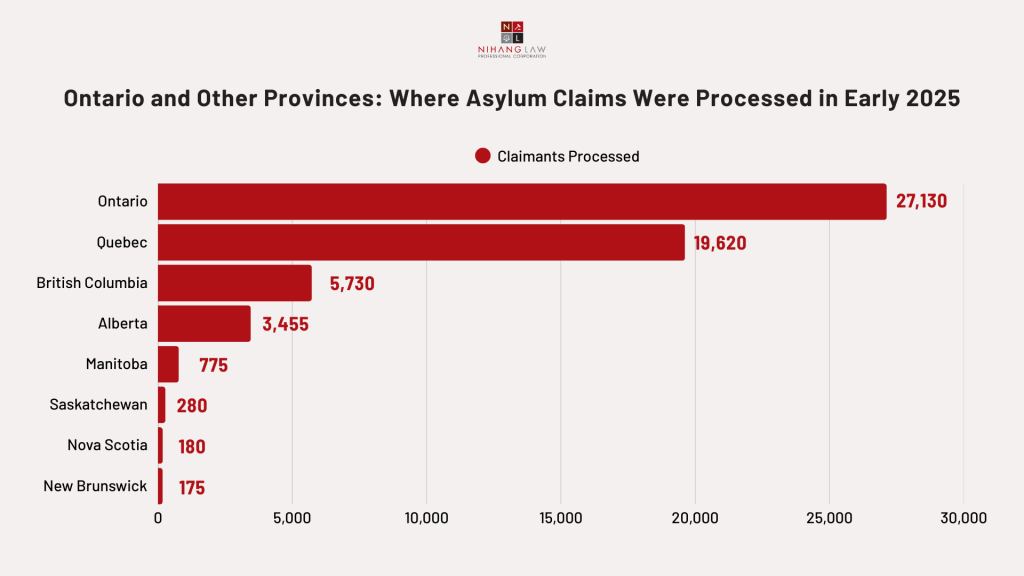
Ontario readers should also know that this is not a rare issue. IRCC’s preliminary data for January to June 2025 shows Ontario had 27,130 total asylum claimants processed by CBSA and IRCC, the highest provincial total in the published table, which is one reason the PRRA-versus-claim confusion comes up so often in Ontario practice. IRCC also notes that this data is preliminary and subject to change.
Figure 1: Ontario and Other Provinces: Where Asylum Claims Were Processed in Early 2025
Nihang Law Insight
One of the most common mistakes in Ontario consultations is treating PRRA as the “main” place to explain danger. Usually, it is not. If a refugee claim is still legally available, waiting can create avoidable problems with timing, credibility, and evidence.
What is the Difference Between PRRA and Refugee Claim in Canada?
A refugee claim is the primary protection process for someone who is still eligible to seek asylum in Canada. A Pre-Removal Risk Assessment (PRRA) is a later, removal-stage protection application for a person already under an enforceable removal process and found eligible by CBSA. They are related, but they are not interchangeable.
A refugee claim begins with an eligibility screening. If eligible, the claim is referred to the IRB, which decides whether the person is a Convention refugee or a person in need of protection.
A PRRA is governed by a different part of the IRPA. Under section 112, a person subject to a removal order in force may apply for protection in accordance with the regulations, but only if they are not barred and only when the system actually makes PRRA available to them.
The same legal protection concepts may appear in both processes, but the stage, gatekeeping rules, and evidence rules are different. That is why “I have risk to life” does not answer the more important legal question: Are you still at the claim stage, or are you already at the removal stage?
The table below summarizes the current federal framework.
Feature | Refugee claim | PRRA |
When it happens | Before the IRB hearing process, if the person is eligible to claim | Later, when removal is being enforced and CBSA says the person is |
Decision-maker | IRB Refugee Protection Division | IRCC PRRA officer |
Core legal grounds | Section 96 and section 97 | Usually section 96 and/or section 97, subject to limits for some |
Can you start it on demand? | Only if your claim is legally eligible | No; CBSA must notify you that you may apply |
Evidence format | Full claim record, hearing evidence, documents, testimony | Usually written; hearing only in limited situations |
If successful | Protected person status; may apply for permanent residence | In most cases protected person status; in some serious |
If refused | Removal may follow, subject to other remedies | Removal proceeds unless a court grants a stay |
Can a Refugee Claim Itself Be Based on Risk to Life?
Yes. A refugee claim can be based not only on section 96 persecution grounds, but also on section 97 protection grounds. Section 97 covers danger of torture, risk to life, and risk of cruel and unusual treatment or punishment, so “risk to life” is not exclusive to PRRA.
Section 96 covers a well-founded fear of persecution for reasons such as race, religion, nationality, membership in a particular social group, or political opinion. Section 97 covers a different type of protection risk: torture, risk to life, or cruel and unusual treatment or punishment.
Under the IRB’s legal guidance, a section 96 persecution case includes a subjective and objective fear component. By contrast, section 97 focuses on a personalized risk; the risk must apply to the individual personally and cannot rest only on generalized country violence.
The IRPA also says the section 97 risk must exist in every part of the country, must not be merely a lawful sanction, and must not be caused by that country’s inability to provide adequate health or medical care.
Nihang Law Insight
In practice, the first legal question is often not “How dangerous is this country?” but “What kind of danger is this under Canadian law?” The answer may change the entire strategy.
Who is Eligible for PRRA in Canada and When Does the 12-Month Bar Apply?
PRRA is usually available only when a person is already facing removal and CBSA confirms eligibility. In most cases, a person must also wait 12 months after the last negative refugee or PRRA outcome before applying, unless a current country exemption applies. Some people are not eligible at all.
The current IRCC guidance says a person can apply only if a CBSA officer tells them they are eligible.
The guidance also says that, in most cases, there is a 12-month waiting period after the last negative IRB or PRRA decision, or after abandonment, withdrawal, or an unsuccessful Federal Court challenge.
IRCC also lists people who cannot apply for a PRRA, including certain people whose refugee claim was ineligible because of the Safe Third Country Agreement, people already recognized as refugees in another country they can return to, people who already have refugee protection in Canada, and people subject to extradition.
How Do the Evidence Rules and Procedure Differ?
A refugee claim usually involves a full IRB determination, typically with a hearing. A PRRA is usually a written process, with a hearing only in limited circumstances. After a refused refugee claim, a PRRA cannot usually be used to recycle the same evidence; the law focuses on qualifying new evidence.
For an eligible refugee claim, IRCC refers the file to the IRB, and the IRB schedules a hearing to decide whether the person meets the Convention refugee or person-in-need-of-protection definition. While waiting, an eligible claimant may receive referral documents, IFHP access, and an open work permit if the claim was referred and the medical exam requirement is met.
A PRRA is different. IRCC describes it as a process that is normally assessed on the basis of written information, with a hearing only if credibility is central or in limited other circumstances. Section 113 of the IRPA says that where a refugee claim was already rejected, the applicant may present only new evidence that arose later, was not reasonably available, or could not reasonably have been presented earlier. IRCC repeats the same rule in its PRRA guidance.
What Counts as New Evidence in a PRRA After a Refused Refugee Claim?
New evidence in a PRRA usually means evidence that arose after the refugee claim was refused, was not reasonably available at the time of the hearing, or could not reasonably have been presented earlier. PRRA is not usually a second full hearing on the same facts. It is more often a focused written application showing what is new, what changed, and why the current removal would now create a legally recognized risk.
Examples may include new threats, updated country-condition evidence, newly available police or medical records, or fresh corroborating documents that were not reasonably obtainable earlier.
There are also practical differences in work authorization. During an eligible refugee claim, an open work permit may issue once the claim is referred and the medical exam is passed. During a PRRA, work authorization is more limited: on a first PRRA, a timely applicant may apply for a work permit if they do not already have one, but later or non-first PRRA applicants generally cannot work on that basis.
Nihang Law Insight
A strong PRRA is usually built around a change: new threats, new country developments, new documentary proof, or a procedural path that made the person claim-ineligible but still exposed to risk. Repeating the original record without a real update is usually not enough.
What Happens After a Refugee Claim Is Refused and Removal Starts?
A refused refugee claim does not always mean the legal process is over. The usual sequence is: potential asylum claim, eligibility screening, IRB referral and hearing, decision, possible further remedies, and then removal enforcement if the person is unsuccessful. PRRA usually appears near the end of that sequence, not at the beginning. Mistakes about timing at any stage may affect what legal options remain available.
If your refugee claim has already been refused, you may also want to read our guide on appealing a refused refugee claim in Canada to understand when an appeal may be available and how that process differs from PRRA.
How the Process Usually Unfolds
- Asylum stage begins: The person asks for refugee protection and must first meet eligibility requirements. Claims may be ineligible for reasons such as prior rejected or withdrawn claims, certain inadmissibility findings, or land-border entry from the United States.
- Eligibility decision: If the claim is eligible, it is referred to the IRB. If not, the person is referred to CBSA for removal.
- Claim pending: While waiting, an eligible claimant can work, study, and access support services, with open work permit eligibility tied to referral and a medical exam. IRCC’s June 2025 committee materials reported an average of 68 days from claim submission to work permit approval as of April 30, 2025.
- IRB determination: The IRB decides whether the person is a Convention refugee or person in need of protection. If accepted, the person becomes a protected person and may apply for permanent residence. If rejected, removal may follow unless another remedy applies.
- Removal stage: Once CBSA begins enforcing removal, the officer checks PRRA eligibility. In most cases, a refused claimant must wait 12 months before a PRRA is available.
- PRRA stage: If eligible, the person must file on time, usually with focused written submissions and qualifying new evidence. A first timely PRRA can suspend removal while the application is processed.
This sequence also helps explain current system pressure. IRCC reported that, as of June 30, 2025, the IRB had 190,300 claims ready to be heard, another 98,000 incomplete claims, and an average wait time of 17 months from “ready for adjudication” to decision. As of August 31, 2025, IRCC also reported that 80% of asylum eligibility decisions were being made within 21 days.
Figure 2. Canada Asylum Claim Volumes: January to August Comparison

What Mistakes Do People Make When They Confuse PRRA With Asylum?
The most common mistakes are procedural, not emotional: waiting too long to claim, assuming PRRA can be chosen whenever needed, treating PRRA as a second hearing, misunderstanding section 97, and missing removal-stage deadlines. These errors may weaken a case even where real risk exists.
Common mistakes include:
- Assuming “risk to life” automatically means PRRA rather than an asylum claim
- Ignoring that a refugee claim can itself be based on section 97 risk grounds
- Waiting until CBSA starts removal before getting legal advice
- Filing a PRRA late and losing the removal stay that may come with a first timely application
- Recycling the same evidence after a refused claim without showing what is genuinely new
- Relying only on generalized country violence without linking the risk personally to the claimant
- Confusing refugee protection with H&C hardship arguments or medical-access arguments that may need a different legal framing.
Common Questions About PRRA and Refugee Claims
Can I choose PRRA instead of making a refugee claim?
A person usually cannot simply choose PRRA first. PRRA is generally available only when the person is already facing removal and CBSA tells them they are eligible to apply. If a refugee claim is still available, that is usually the earlier protection route.
What Happens If Your Refugee Claim Is Ineligible and You Are Directed to PRRA?
If a refugee claim is found ineligible, the case does not go to the IRB for a full refugee hearing. In some situations, the person may later be considered for PRRA instead, but PRRA is a separate removal-stage process with different eligibility rules, filing steps, and evidence limits. It should not be assumed that an ineligible claim automatically results in immediate PRRA access.
Does “risk to life” automatically qualify me for protection?
No. Section 97 requires a personalized risk. The risk must not be merely general risk faced by others, must exist in every part of the country, and must not be based only on inadequate health or medical care in that country.
Can You Apply for PRRA After a Refugee Claim Refusal in Canada?
Usually not. In most cases, a person must wait 12 months after the last negative refugee or PRRA decision, or after withdrawal, abandonment, or an unsuccessful Federal Court challenge. A PRRA also is not started on demand; CBSA must first determine that the person is eligible to apply.
Can I file a PRRA using the same documents I already used at my hearing?
Usually not by itself. Section 113 limits a PRRA after a refused refugee claim to qualifying new evidence that arose later, was not reasonably available, or could not reasonably have been presented earlier. PRRA is not designed as a full replay of the original record.
Can a PRRA Stop Removal From Canada?
Not always. A first PRRA filed on time may keep a removal stay in place while IRCC processes the application. However, late PRRAs, subsequent PRRAs, and port-of-entry PRRAs do not receive that same protection automatically. Timing is therefore one of the most important practical issues in PRRA cases.
Can I work while my matter is pending?
Often yes, but the rules differ. Eligible refugee claimants may receive an open work permit after referral and a medical exam. First-time, timely PRRA applicants may have limited work-permit options, but later PRRA applicants generally cannot work on that basis.
What if my case is really about hardship, family ties, or lack of medical care?
That may point to a different or additional strategy. H&C is a separate framework, and section 25(1.3) says H&C cannot decide the same section 96 and 97 protection questions. The legal analysis may therefore be very different from a refugee claim or PRRA.
Key Takeaways and How Nihang Law Can Help
The key legal point is simple: “risk to life” is not the opposite of asylum. In Canada, that risk may be argued within a refugee claim under section 97 if the claim is still eligible. PRRA is not a substitute that a person can freely choose at any time; it is usually a later, removal-stage process with stricter access and evidence rules.
If you are in Ontario and trying to decide between a refugee claim strategy, a PRRA strategy, or a parallel hardship-based strategy, the most important questions are procedural: Where is the file right now? What prior decisions exist? Has CBSA started removal? What evidence is genuinely new? Those answers often decide the right path before the merits are even argued.
Reminder: Do not rely on general online information if you have already received a CBSA reporting direction, removal interview, or PRRA notification. Those documents often mean the case has entered a different legal stage with different deadlines.
Nihang Law can help assess where your immigration matter sits in the federal protection process, identify whether a refugee claim is still legally available, determine whether a PRRA is actually accessible, and build a strategy around the right evidence rather than the wrong label.
Sources & References
- Immigration and Refugee Protection Act, section 96
https://laws-lois.justice.gc.ca/eng/acts/I-2.5/section-96.html - Immigration and Refugee Protection Act, section 97
https://laws-lois.justice.gc.ca/eng/acts/I-2.5/section-97.html - Immigration and Refugee Protection Act, section 101
https://laws-lois.justice.gc.ca/eng/acts/I-2.5/section-101.html - Immigration and Refugee Protection Act, section 112
https://laws-lois.justice.gc.ca/eng/acts/I-2.5/section-112.html - Immigration and Refugee Protection Act, section 113
https://laws-lois.justice.gc.ca/eng/acts/I-2.5/section-113.html - Immigration and Refugee Protection Act, section 114
https://laws-lois.justice.gc.ca/eng/acts/I-2.5/section-114.html - Immigration and Refugee Protection Act, section 25
https://laws-lois.justice.gc.ca/eng/acts/I-2.5/section-25.html - Claiming refugee protection (asylum) from within Canada: Meet the requirements
https://www.canada.ca/en/immigration-refugees-citizenship/services/asylum/in-canada/eligibility.html - Claiming refugee protection (asylum) from within Canada: After you submit your claim
https://www.canada.ca/en/immigration-refugees-citizenship/services/asylum/in-canada/after-apply.html - Claiming refugee protection (asylum) from within Canada: While you wait
https://www.canada.ca/en/immigration-refugees-citizenship/services/asylum/in-canada/while-you-wait.html - Claiming refugee protection (asylum) at the border: After your hearing
https://www.canada.ca/en/immigration-refugees-citizenship/services/asylum/border/after-your-hearing.html - Pre-removal risk assessment: Who can apply
https://www.canada.ca/en/immigration-refugees-citizenship/services/refugees/protection/refusal-options/pre-removal-risk-assessment/eligibility.html - Pre-removal risk assessment: How to apply
https://www.canada.ca/en/immigration-refugees-citizenship/services/refugees/protection/refusal-options/pre-removal-risk-assessment/how-to-apply.html - Pre-removal risk assessment: After you apply
https://www.canada.ca/en/immigration-refugees-citizenship/services/refugees/protection/refusal-options/pre-removal-risk-assessment/after-apply.html - Pre-removal risk assessment: Decision on your application
https://www.canada.ca/en/immigration-refugees-citizenship/services/refugees/protection/refusal-options/pre-removal-risk-assessment/decision.html - Pre-removal risk assessment: Exemptions to the 12-month wait period
https://www.canada.ca/en/immigration-refugees-citizenship/services/refugees/protection/refusal-options/pre-removal-risk-assessment/exceptions.html - Options for asylum claimants whose claim has been rejected
https://www.canada.ca/en/immigration-refugees-citizenship/services/refugees/protection/refusal-options.html - Guide 5523 – Applying for a Pre-Removal Risk Assessment
https://www.canada.ca/en/immigration-refugees-citizenship/services/application/application-forms-guides/guide-5523-applying-removal-risk-assessment.html - Guide 5205 – Applying for permanent residence within Canada as a protected person or Convention refugee
https://www.canada.ca/en/immigration-refugees-citizenship/services/application/application-forms-guides/guide-5205-applying-permanent-residence-within-canada-protected-persons-convention-refugees.html - Guide 5291 – Humanitarian and Compassionate Considerations
https://www.canada.ca/en/immigration-refugees-citizenship/services/application/application-forms-guides/guide-5291-humanitarian-compassionate-considerations.html - IRB Legal Concepts: Well-founded fear
https://www.irb-cisr.gc.ca/en/legal-policy/legal-concepts/Pages/RefDef05.aspx - IRB Legal Concepts: Persons in need of protection
https://www.irb-cisr.gc.ca/en/legal-policy/legal-concepts/Pages/RefDef14.aspx - Asylum statistics, trends and data
https://www.canada.ca/en/immigration-refugees-citizenship/corporate/reports-statistics/statistics-open-data/immigration-stats/asylum-claims.html - Asylum claimants by year – January to June 2025
https://www.canada.ca/en/immigration-refugees-citizenship/services/refugees/asylum-claims/asylum-claims-2025.html - COW – Asylum – June 9, 2025
https://www.canada.ca/en/immigration-refugees-citizenship/corporate/transparency/committees/cow-jun-9-2025/asylum.html - CIMM – Asylum – October 30, 2025
https://www.canada.ca/en/immigration-refugees-citizenship/corporate/transparency/committees/cimm-oct-30-2025/asylum.html
Thank you for reading this post, don't forget to subscribe!