



5th March 2026BY Nihang Law
Notarizing Separation Agreements in Ontario: Why the Independent Legal Advice (ILA) Certificate Is the Most Important Page
Last Updated: March 2026
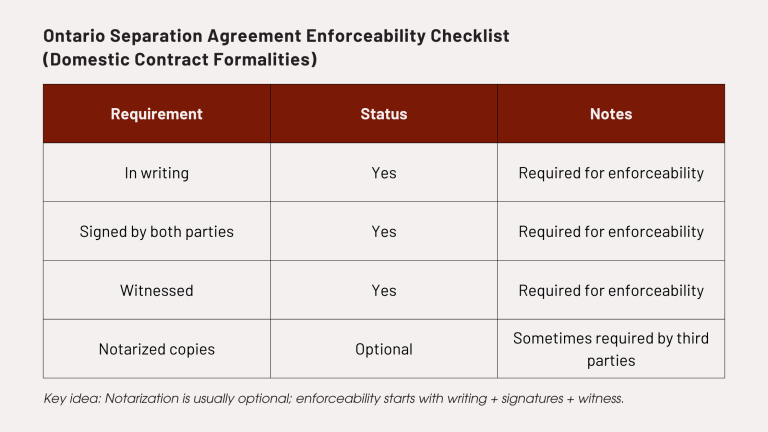
In Ontario, you usually don’t need to notarize a separation agreement for it to be valid, but it generally must be in writing, signed, and witnessed to be enforceable under the Family Law Act.
Independent Legal Advice (ILA) is not always legally required, but an ILA certificate is often the strongest evidence that you understood the agreement and signed voluntarily—two issues that commonly drive later challenges.
A notary can authenticate identities and signatures, but notarization does not replace proper disclosure, fairness, and informed consent.
If support terms need enforcement through the court process, there are specific filing steps and forms (such as Form 26B) that may apply.
If you’re trying to notarize a separation agreement in Ontario, it’s usually because you want one step that makes everything feel “final.” If you’re separating, it’s normal to want the “one step” that makes everything safe: “Let’s just notarize it so it can’t be challenged.” In Ontario, that instinct can be expensive—because the risk usually isn’t a missing stamp. The real risk is what happens years later, when someone says: “I didn’t understand what I was signing,” or “I signed because I had no choice,” or “I didn’t know the finances.”
Those are the arguments that can reopen a deal you thought was settled—especially where support or property is involved. Ontario law generally encourages separation agreements, but courts can still set them aside in certain circumstances under the Family Law Act—and the paperwork that helps most is often not the notarization page.
This guide explains how notarization, witnessing, and Independent Legal Advice (ILA) actually work, and why the ILA certificate is often the page that protects the agreement when it matters most.
Legal Disclaimer: This article provides general legal information for Ontario, not legal advice. Domestic contracts are fact-specific, and outcomes may differ based on your situation. If you need advice for your circumstances, speak with a lawyer.
Quick Start: Pick Your Path
If you’re looking to notarize a separation agreement in Ontario to “lock it in,” start by making sure the witnessing and ILA steps are done properly.
You have a draft agreement and want it “locked in.”
- Focus on: proper witnessing + full financial disclosure + ILA certificate(s).
You already signed something and now you’re worried.
- Focus on whether the statutory formalities were met (writing, signature, witness) and whether a new properly executed agreement or legal advice is needed.
A bank, employer, or immigration process is asking for notarization.
- Focus on notarization as an identity or authentication step, but still get ILA if you want enforceability protection.
Your agreement includes child support or you want court enforcement.
- Focus on child support guidelines context and filing steps (including Form 26B, where applicable).
Do I Need To Notarize A Separation Agreement In Ontario?
Usually, no. In Ontario, separation agreements are treated as “domestic contracts” and are generally enforceable when they meet the Family Law Act formalities—in writing, signed, and witnessed. Notarization can help confirm identity and execution, but it typically does not replace the legal protections provided by Independent Legal Advice (ILA).
What notarization actually does (and doesn’t do)
Under Ontario’s Notaries Act, a notary public may witness or certify the execution of a document and certify true copies. That can be helpful when a third party wants comfort that the signatures are authentic or the document will be used outside Ontario or in a process that expects notarized copies.
However, notarization generally does not:
- prove you received fair disclosure;
- prove you understood your rights and the consequences; or
- prevent a later argument of pressure, duress, or unconscionability.
Those are precisely the issues that show up in challenges to domestic contracts.
Figure 1: Ontario Separation Agreement Enforceability Checklist (Domestic Contract Formalities)
What Makes a Separation Agreement Enforceable Under Ontario’s Family Law Act?
A separation agreement is a domestic contract. Under Ontario’s Family Law Act, a domestic contract is generally unenforceable unless it is made in writing, signed by the parties, and witnessed. Even when those formalities are met, the agreement may still be challenged later if disclosure, understanding, or voluntariness is in dispute.
A practical point about “witnessing”
Witnessing is not just a technicality—it helps with evidence later (who signed, when, and whether execution looked voluntary). Courts have also discussed when strict formality arguments should (and should not) defeat an otherwise genuine agreement, but relying on a “maybe the court will relax it” approach is risky planning.
Nihang Law Insight
When agreements get attacked, the story often isn’t “the notary was missing.” It’s “we signed quickly, without exchanging full documents, and now the numbers don’t make sense.” Formal execution helps—but it’s the process (disclosure + ILA + clean signing) that makes the agreement harder to unravel later.
What is Independent Legal Advice (ILA), and Why is it So Important?
Independent Legal Advice (ILA) means each person gets advice from their own lawyer (independent from the other side) about rights, obligations, options, and consequences before signing. It’s not always strictly required by statute, but it can be critical evidence that you understood the agreement and signed voluntarily, which are key issues in later challenges.
Many people in Ontario focus on whether to notarize a separation agreement, but the ILA certificate is often the page that matters most if the agreement is challenged later.
Why the ILA certificate is often “the most important page”
The Law Society of Ontario (LSO) specifically recommends documenting ILA by providing a written certificate and having the client sign a copy.
That certificate becomes:
- proof you were advised of legal rights you may be releasing,
- proof the lawyer assessed capacity/voluntariness concerns (where relevant),
- proof you had the opportunity to ask questions and decline signing.
In real disputes, a judge may not be able to “re-live” the signing day. The certificate (and the lawyer’s file) often becomes the clearest snapshot of whether the agreement was informed and voluntary.
What Should an ILA Certificate Include for a Separation Agreement?
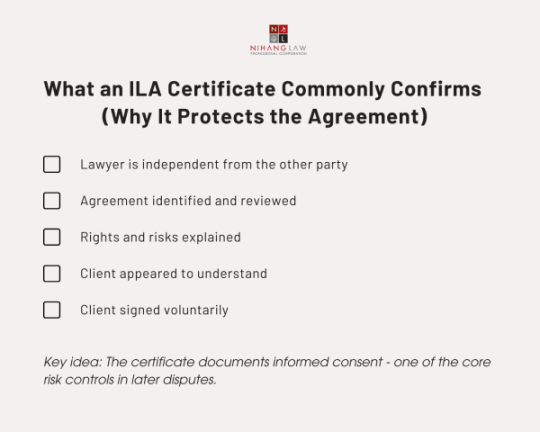
A strong ILA certificate typically confirms the lawyer is independent, identifies the agreement, confirms advice was given on rights and consequences, confirms the client appeared to understand, and confirms the client signed voluntarily. The LSO encourages written documentation of ILA, including a signed certificate retained on file.
Typical coverage areas (what your lawyer may review with you)
While formats vary, a separation-agreement ILA commonly addresses:
- property division framework and what you may be giving up;
- support rights (child/spousal) and how courts view agreements;
- financial disclosure received and what’s missing;
- warning signs: pressure, rushing, language barriers, capacity concerns.
Nihang Law Insight
If you want the certificate to actually protect you, bring the financial documents and insist the lawyer has time to review them. An “ILA appointment” with no disclosure is like an inspection with the lights off—there’s only so much anyone can responsibly confirm.
Figure 2: What an ILA Certificate Commonly Confirms (Why It Protects the Agreement)
When Can A Court Set Aside A Separation Agreement In Ontario?
Under Ontario’s Family Law Act, a court may set aside a domestic contract if, for example, there was significant non-disclosure of assets/debts, a party did not understand the nature or consequences, or other contract-law grounds apply (like duress or unconscionability).
The big three risk triggers
- Disclosure problems: Lack of full and honest financial disclosure is a classic trigger for litigation over domestic contracts.
- Understanding/capacity: If a party plausibly didn’t understand what they signed, the deal is more exposed.
- Pressure/inequality in negotiation: Courts scrutinize unfairness in the bargaining process, especially where the outcome is extreme.
Why “we notarized it” doesn’t end the analysis
Even if a notary confirms identity and execution, the court can still ask: Was there meaningful disclosure? Was there real understanding? Was there pressure? Those are ILA questions, not notarization questions.
How Do Notarization, Witnessing, And ILA Compare?
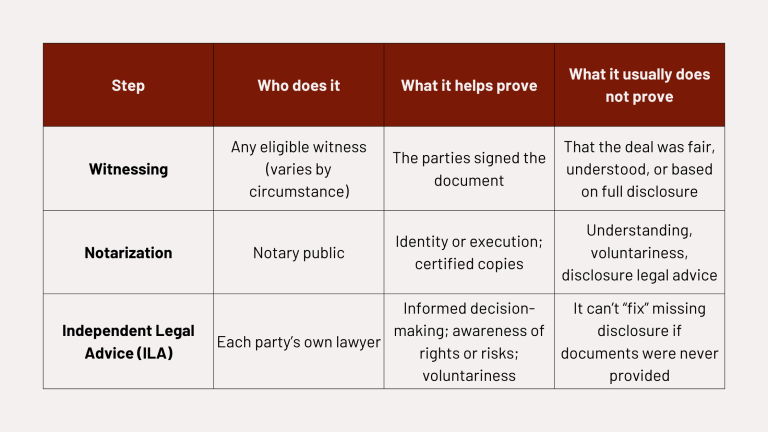
Think of these as three different functions. Witnessing helps meet Ontario domestic contract formalities and creates evidence of signing. Notarization authenticates identity/execution for third parties. ILA addresses the biggest legal risks—knowledge, voluntariness, and informed consent—and the ILA certificate documents that protection.
Figure 3: Witnessing vs Notarization vs Independent Legal Advice in Ontario: What Each Step Proves (and What It Doesn’t)
What is the Step-By-Step Roadmap to Sign Safely (And Keep The Agreement Enforceable)?
The safest process is: exchange full financial disclosure, negotiate terms with time to reflect, have each party obtain ILA, then sign the final agreement with proper witnessing (and notarize copies only if needed for third parties). This sequence reduces the most common legal attack points under the Family Law Act.
Step-by-step roadmap
- Confirm what issues the agreement covers (property, support, parenting, debts).
- Gather and exchange financial disclosure (income, assets, debts, valuations where needed).
- Prepare a clean final draft (avoid handwritten edits at signing).
- Book separate ILA appointments (one lawyer per person).
- Each lawyer reviews: rights, consequences, alternatives, and disclosure gaps.
- Sign ILA certificate(s) and keep copies with the agreement.
- Sign the separation agreement with proper witnessing.
- If a third party requires it, notarize the signed copies (optional add-on step).
- If support enforcement through court filing is needed, complete the required court form(s) (often Form 26B) and file appropriately.
How Do You File a Separation Agreement to Enforce Support Terms?
If you want the support terms treated like a court order for enforcement or variation purposes, Ontario’s family court process may allow filing the domestic contract with the court, typically using Form 26B (Affidavit for Filing Domestic Contract). The correct approach depends on what part of the agreement you are trying to enforce.
Child support reminder (important)
Even if spouses “agree” to something different, child support is closely tied to statutory guidelines and the court’s obligation to ensure reasonable arrangements for children in divorce proceedings. If your agreement includes child support, it should be drafted carefully and with current guideline context.
Common Mistakes That Make Separation Agreements Easier To Challenge
- Signing without exchanging meaningful financial disclosure.
- Treating notarization as a substitute for ILA.
- One lawyer “helping both spouses” (conflict risk).
- Rushing a signing the night before someone moves out / travels / remarries.
- Vague terms (support review triggers, valuation dates, debt responsibility).
- Handwritten changes at signing with no re-advice.
- Ignoring child support guideline reality (agreeing to $0 without a proper basis).
Frequently Asked Questions
Do I need to notarize a separation agreement in Ontario for it to be valid?
In Ontario, you can notarize a separation agreement, but notarization is usually not required for validity if it is properly in writing, signed, and witnessed. Notarization may help with identity or third-party requirements, while ILA helps address understanding, voluntariness, and risk of later challenges.
Can we write our own separation agreement and just notarize it?
You can draft your own agreement, and notarization can authenticate signatures, but that doesn’t address the biggest legal risks—disclosure, understanding, and voluntariness. Ontario domestic contracts generally need to be in writing, signed, and witnessed to be enforceable, and ILA documentation can be key protection later.
Can one lawyer give Independent Legal Advice to both spouses?
Typically, no. ILA is “independent” because each person receives advice from a lawyer whose loyalty is only to them. Acting for both parties often creates a conflict of interest. The Law Society’s guidance emphasizes conflict management and independence when ILA is required or recommended.
If my spouse refuses ILA, does that make the agreement invalid?
Not automatically. ILA is not always a strict legal requirement for validity, but refusing ILA can increase the agreement’s vulnerability if there’s later a claim of misunderstanding or pressure. A lawyer may advise you not to sign (or to revise terms) if the process is not reliable.
What if we already signed. Can we “add” ILA after the fact?
You can still obtain legal advice after signing, but ILA is most protective when it happens before execution. If there are concerns about disclosure, pressure, or unclear terms, the safer fix may be a properly re-negotiated and re-signed agreement (with witnessing) rather than a late certificate.
Will a court always enforce our separation agreement?
No guarantees. Courts often respect separation agreements, but the Family Law Act allows them to be set aside in certain circumstances (including significant non-disclosure or lack of understanding). Major Supreme Court cases also show that unconscionability, exploitation, or flawed bargaining can matter.
Can a separation agreement waive child support?
Child support is guided by statutory guidelines and judicial oversight. Even where parents agree, a court may scrutinize whether arrangements are reasonable when child support is in issue in a divorce proceeding, and the Federal Child Support Guidelines provide the framework for amounts and exceptions.
Do we need to file our separation agreement with the court?
Not always. Many couples keep a separation agreement as a private contract. But if you need the support provisions enforced or treated like a court order, Ontario’s process may involve filing the contract using Form 26B and related steps at the family courthouse, depending on what you’re enforcing.
What documents should I bring to my ILA appointment?
Bring the final draft agreement, a summary of key issues you’re settling, and the financial disclosure you received (income proof, assets, debts, valuations if relevant). ILA is strongest when advice is based on real disclosure—because disclosure problems are a major reason domestic contracts get challenged.
Key Takeaways and How Nihang Law Can Help
Notarization can be useful—but in Ontario family law, it’s rarely the “magic shield” people hope it is. The page that tends to matter most later is the Independent Legal Advice certificate, because it connects the agreement to the legal themes courts care about: disclosure, understanding, and voluntary signing.
Reminder: This article is general information, not legal advice. If you’re signing (or re-signing) a separation agreement, timelines, safety concerns, and financial complexity can change what the right process looks like.
If you want the agreement to be clear, properly executed, and built to withstand future disputes, Nihang Law Professional Corporation can help you structure the signing process, coordinate ILA where appropriate, and draft terms that are practical under Ontario law—so the agreement reads like a solution, not a future lawsuit.
Sources & References
- Ontario Family Law Act, R.S.O. 1990, c. F.3 (CanLII): https://www.canlii.org/en/on/laws/stat/rso-1990-c-f3/latest/ (org)
- Ontario Notaries Act, R.S.O. 1990, c. N.6 (e-Laws): https://www.ontario.ca/laws/statute/90n06 (ca)
- Law Society of Ontario – Independent legal advice & independent legal representation: https://lso.ca/lawyers/practice-supports-and-resources/topics/the-lawyer-client-relationship/independent-legal-advice-and-independent-legal-rep (ca)
- Divorce Act, R.S.C. 1985, c. 3 (2nd Supp.) (Justice Laws): https://laws-lois.justice.gc.ca/eng/acts/d-3.4/section-11.html (laws-lois.justice.gc.ca)
- Federal Child Support Guidelines, SOR/97-175 (Justice Laws): https://laws-lois.justice.gc.ca/eng/regulations/sor-97-175/index.html (laws-lois.justice.gc.ca)
- Ontario Regulation 391/97 (Child Support Guidelines) (e-Laws): https://www.ontario.ca/laws/regulation/970391 (ca)
- Ontario Court Forms – Form 26B landing page: https://ontariocourtforms.on.ca/en/family-law-rules-forms/26b/ (on.ca)
- Ontario Court Forms – Form 26B PDF: https://ontariocourtforms.on.ca/static/media/uploads/courtforms/family/26b/flr-26b-apr16-en-fil.pdf (on.ca)
- Miglin v. Miglin, 2003 SCC 24 (Supreme Court of Canada): https://decisions.scc-csc.ca/scc-csc/scc-csc/en/item/2055/index.do (scc-csc.ca)
- Rick v. Brandsema, 2009 SCC 10 (Supreme Court of Canada): https://decisions.scc-csc.ca/scc-csc/scc-csc/en/item/6396/index.do (scc-csc.ca)
- LeVan v. LeVan, 2008 ONCA 388 (CanLII): https://www.canlii.org/en/on/onca/doc/2008/2008onca388/2008onca388.html (org)
- Ontario Reports (digital) referencing the Gallacher factors via El Rassi-Wight v. Arnold, 2024 ONCA 2: https://digital.ontarioreports.ca/ontarioreports/20240705/MobilePagedArticle.action?articleId=1988939 (ontarioreports.ca)
Thank you for reading this post, don't forget to subscribe!