



26th March 2026BY Nihang Law
Divorce Order vs. Certificate of Divorce in Ontario: Which One Do You Actually Need?
A divorce order and a certificate of divorce are not the same thing in Ontario. The divorce order is the court’s judgment granting the divorce, and in most cases, the divorce becomes legally effective 31 days later, not the same day the order is made. The certificate of divorce is the later proof document issued on request after the divorce takes effect, and it is the document people commonly need when they want to remarry. The certificate is issued by the court that processed the divorce, not by the federal registry.
Last Updated: March 2026
A lot of people think the hardest part is getting the judge to sign the divorce. Often, the next problem comes later, when a new marriage is being planned, a foreign government asks for proof of divorce, or a person realizes the document they kept is not the one the other institution wants. That is where confusion between a divorce order and a certificate of divorce becomes expensive and stressful. Separation does not equal divorce, and that distinction often causes confusion when people are trying to prove their marital status later.
In Ontario, the divorce usually takes effect 31 days after the order is granted, and the certificate can only be issued on or after that effective date. So if someone assumes they are immediately free to remarry, book travel, or finalize paperwork with only the order in hand, timing and proof issues can arise fast. If you are trying to understand the broader Ontario family law process, it also helps to see how divorce paperwork fits into the larger court process.
Disclaimer: This article is general information only, not legal advice. Family law outcomes depend on the facts, the court record, and the specific orders made in your case.
Quick Start: Pick Your Path
You want to remarry soon:
- You will usually want the certificate of divorce, not just the order.
You need to know when the divorce became legally effective:
- Check the divorce order date and the effective date rules.
You lost your paperwork:
- Start by locating the court file details, and if necessary use the Central Registry of Divorce Proceedings to identify the court.
You need proof for an official process:
- Ask first whether the institution wants the order, the certificate, or both.
What is the Difference Between a Divorce Order and a Certificate of Divorce?
A divorce order is the court order that grants the divorce. A certificate of divorce is the proof document issued later, after the divorce has taken effect. The order creates the divorce result; the certificate proves the divorce and the effective date in a concise, official form.
The Ontario divorce order is Form 25A. It is the document the judge signs to order that the spouses “be divorced,” and it may also include additional relief if applicable. The certificate of divorce is Form 36B. It is much narrower: it certifies that the marriage of the named spouses was dissolved by court order and states the date the divorce took effect. Under the federal Divorce Act, the certificate is conclusive proof of the facts certified in it.
The easiest way to think about it is this: the order is the judgment, while the certificate is the proof of status. One is the legal ruling; the other is the clean evidence people often need later.
Feature | Divorce Order | Certificate of Divorce |
What it is | The court | A |
When issued | When the | After the |
Main purpose | Shows that | Proves that |
What it | The judgment | Confirmation |
Better | Yes | No |
Commonly used | Not usually | Yes |
Nihang Law Insight
In practice, many people should keep both documents. The order may matter because it shows what the judge actually ordered. The certificate matters because it is the cleaner proof that the marriage has legally ended.
When Does a Divorce Order Take Effect in Ontario
Why Does That Date Matter?
In most cases, a divorce takes effect on the 31st day after the judgment granting the divorce is rendered. That effective date matters because the certificate cannot be issued before then, and people should not assume they are immediately free to remarry on the day the judge signs the order.
Section 12 of the federal Divorce Act sets the default rule. It says a divorce generally takes effect on the thirty-first day after the judgment is rendered. The same section also allows for special circumstances where the court may order an earlier effective date, but that is not the ordinary case. If an appeal is pending, the effective date may also be pushed later.
This is one of the most important practical distinctions in the process. A signed order is not always the same thing as an effective divorce. The form of certificate itself warns that it can only be issued on or after the date the divorce takes effect.
Legal Perspective
If remarriage timing matters, do not book around the assumption that the order date and the legal divorce date are the same. A short misunderstanding here can derail licence applications, ceremony timing, or international paperwork.
When Do You Actually Need a Certificate of Divorce?
A certificate of divorce is commonly needed when you want to remarry or when an institution wants formal proof that the marriage was legally dissolved and on what date. The certificate is designed for proof-of-status use, while the order is often more useful when someone needs to see the actual court order.
In Ontario self-help and court guidance, the certificate is specifically identified as the document people need if they want to get married again. That makes sense because the certificate is short, official, and directly tied to the effective date of divorce. The Divorce Act also gives it strong evidentiary weight by making it conclusive proof of the certified facts.
That said, some situations are more document-specific. If a third party wants to see the actual terms of a family court decision, a certified copy of the divorce order may still matter. The certificate is not a detailed order. It is proof that the marriage ended, not a full summary of everything that may have been dealt with in the case.
Situation | Document Usually Needed | Why |
You want to remarry | Certificate of Divorce | It is commonly used as official proof that the divorce is legally effective |
You need proof of the date the divorce took effect | Certificate of Divorce | It confirms the effective date of divorce |
You want to review exactly what the judge ordered | Divorce Order | It contains the judgment itself |
You are responding to an institution asking for proof that you are divorced | Usually Certificate of Divorce | It is the cleaner proof document for legal status |
You need to check the wording of the court’s ruling | Divorce Order | It shows the actual order made by the court |
You need both proof of divorce and the underlying court ruling | Both | One proves status; the other shows the judgment |
How Do You Get a Certificate of Divorce in Ontario?
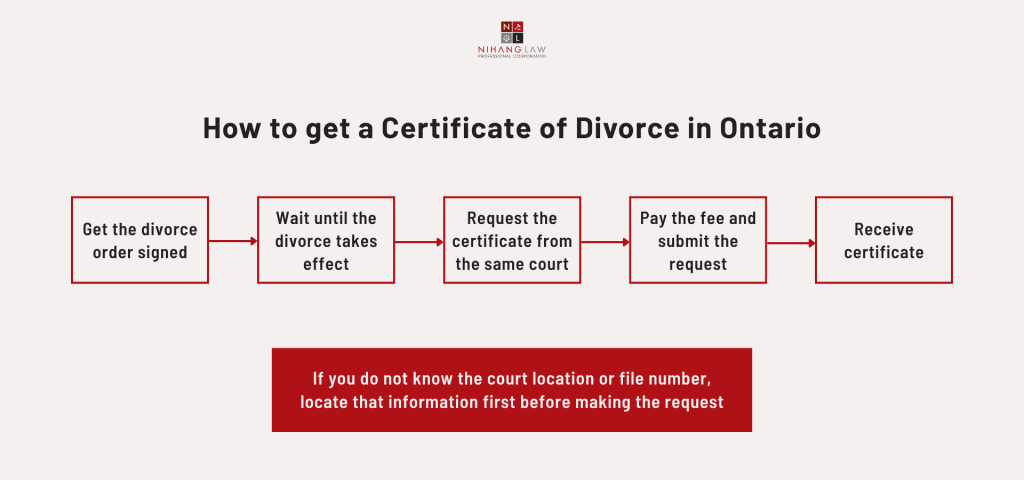
You request the certificate from the court that processed the divorce after the divorce has taken effect. Ontario guidance says you can request it online, in person, or by mail. The certificate fee is $25, and online requests now use a My Ontario Account through Justice Services Online.
Ontario guidance explains that, to get a divorce certificate, you typically need a copy of the divorce order. If you do not have the order, you should try to locate the court address, court file number, and year of divorce. If you cannot remember which court handled the matter, the federal Central Registry may be able to give you the court address and a reference number, but it does not issue the certificate itself.
Ontario’s divorce checklist states that if you require a certificate of divorce, you must request it from the court office where the divorce order was made. The same checklist states that the fee is $25.00 and that the request may be made online using Form 36B through Family Submissions Online. Ontario search results for the government document request page and the family court fees regulation also identify a $25 certificate fee.
Rule 36 of the Family Law Rules also matters here. It says that when the divorce takes effect, the clerk may issue the divorce certificate on request after checking that no appeal has been taken, or that any appeal issues have been resolved or the time has expired.
Figure 1: How To Get A Certificate of Divorce in Ontario
Nihang Law Insight
Clients often focus on “how do I get the certificate,” but the real time-saver is keeping the file number, a copy of the signed order, and the exact court location. That usually makes a later certificate request much smoother.
What Does the Step-By-Step Roadmap Look Like from Divorce Order to Certificate?
The practical roadmap is usually: obtain the signed divorce order, confirm the order date, wait until the divorce takes effect, ensure there are no outstanding appeal issues, then request the certificate from the court that processed the divorce. If the file details are missing, use the federal registry to identify the court first.
A practical roadmap usually looks like this:
1. Get the signed divorce order.
- In simple or joint divorces, the clerk may mail or email the order depending on how the case was filed.
2. Check the order date carefully.
- That date starts the usual 31-day clock under the Divorce Act.
3. Do not assume the divorce is immediately effective.
- The effective date is usually later than the order date.
4. Confirm there is no appeal problem.
- Rule 36 requires the clerk to verify appeal status before issuing the certificate.
5. Request Form 36B from the same court that processed the divorce.
- Use online, in-person, or mail options as available.
6. Keep both documents in a safe place.
- Many later administrative problems arise because only one of the two is retained.
A related point that catches people by surprise is court location. Ontario’s own court information explains that the Ontario Court of Justice does not hear divorce or property cases, so a person looking for divorce paperwork must make sure they are dealing with the correct court system and courthouse.
What Common Mistakes Create Delay or Confusion?
The most common mistakes are treating the order and certificate as interchangeable, assuming the divorce is effective the same day as the order, losing the court file information, contacting the federal registry for the certificate itself, and waiting until a remarriage deadline to sort out proof. These mistakes are avoidable.
Common mistakes include:
- Thinking the divorce order itself automatically equals final proof for every later purpose.
- Assuming the judge’s signature date is the legal divorce date in every case.
- Waiting until a marriage licence or ceremony timeline is already tight before checking what proof is needed.
- Losing the file number, court location, or signed order, which slows down later requests.
- Contacting the Central Registry expecting it to issue the certificate, when it only helps locate the court/file information.
- Going to the wrong court counter or assuming the Ontario Court of Justice handles divorce records.
What Questions Do People Frequently Ask About Divorce Orders and Divorce Certificates?
Most follow-up questions are really about timing, remarriage, missing records, and what to do if the order exists but the certificate has not yet been requested. The answers usually turn on the effective date of divorce and which court has the file.
Can I remarry in Ontario with only my divorce order?
Usually, people are told to obtain the certificate of divorce if they want to remarry. The order may show the judgment, but the certificate is the usual proof document confirming that the marriage was dissolved and the date it took effect.
Do I have to wait 31 days after the divorce order?
In most cases, yes. The Divorce Act says the divorce generally takes effect on the thirty-first day after the judgment is rendered. A shorter period is possible only in special circumstances if the court orders it.
Is a separation the same thing as a divorce?
No. Separation does not equal divorce. A couple may be separated for family law purposes without being legally divorced, and that distinction can matter when someone later needs formal proof that the marriage was dissolved.
Can I get the certificate on the same day the judge signs the order?
Usually not. Form 36B itself states that the certificate can only be issued on or after the date on which the divorce takes effect. In the ordinary case, that will be after the 31-day period has passed.
What if I do not know which court granted my divorce?
You can contact the Central Registry of Divorce Proceedings. It cannot give you the certificate, but it may be able to provide the court address and a reference number to help the court locate the file.
How do I apply if I lost my divorce order?
Ontario guidance says you should try to identify the court address, file number, and year the divorce was granted. If you do not have those details, check your old court forms or use the federal registry to help identify the court first.
Is there a fee for a certificate of divorce in Ontario?
Yes. Ontario government guidance and Ontario court materials identify a $25 fee for the issuance of the certificate of divorce.
How long does a simple or joint divorce usually take before I even get to the certificate stage?
Ontario self-help guidance says a simple divorce often takes about 4 to 6 months, while a joint divorce may take about 3 months, though timing varies by court and paperwork quality. The certificate comes later, after the divorce takes effect. For a fuller discussion of timelines, see our guide on how long an uncontested divorce may take in Ontario.
Key Takeaways and How Nihang Law Can Help
The key legal point is simple: the divorce order is the judgment granting divorce, and the certificate of divorce is the proof document usually needed later to show that the marriage was dissolved and when it became effective. In Ontario, that timing distinction matters because the divorce is usually effective 31 days after the order, not immediately.
If you are unsure which document you need, whether your divorce is already effective, or how to retrieve missing Ontario court records, careful file review can prevent avoidable delay. Nihang Law can help you understand the status of your divorce, identify the right Ontario court process, and plan the next step without making risky assumptions.
Reminder: This article is general information only. Before acting on remarriage timing, international paperwork, or court record issues, get advice on the exact facts and documents in your case.
Sources & References
Government and court sources used in this article include:
Department of Justice Canada, Divorce Act, section 12
Department of Justice Canada, Fact Sheet – Divorce
Department of Justice Canada, Central Registry of Divorce Proceedings
Ontario Court Forms, Form 36B: Certificate of Divorce
Ontario Court Forms, Application for Divorce Checklist
Steps to Justice, How do I get my divorce certificate?
Steps to Justice, Get your Divorce Order
Steps to Justice, Get your Divorce Order (joint divorce path)
Ontario Court Forms, Family Law Rules Forms
Ontario government search result, Get copies of family law documents from court
Ontario Regulation 417/95 search result, Superior Court of Justice – Family Court – Fees
Thank you for reading this post, don't forget to subscribe!