




25th March 2026BY Nihang Law
Can You Sponsor a Common-Law Partner Before Your Divorce Is Final in Canada?
Yes, in some cases, you may be able to sponsor a new partner before your divorce from your ex is final, but usually not as a spouse. If you are still legally married to your ex, the new relationship is usually assessed under the common-law partner rules, which require at least 12 consecutive months of cohabitation in a genuine conjugal relationship.
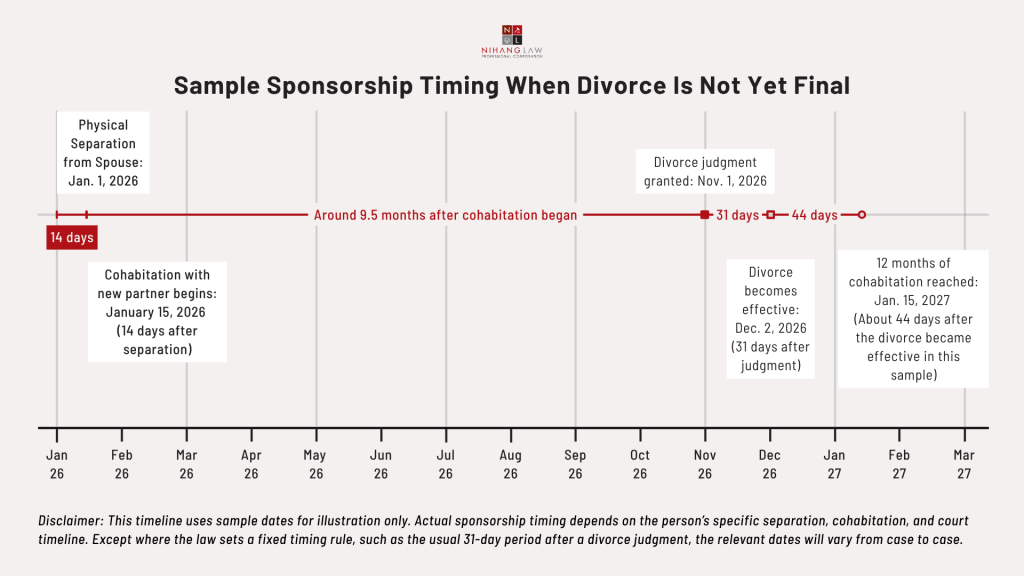
IRCC’s operational guidance states that people married to third parties may still qualify as common-law partners if the prior marriage has broken down, there was a physical separation from the spouse first, and the new common-law relationship was then established for at least one year. A divorce judgment itself also does not usually become effective until 31 days after it is granted, unless the court orders otherwise.
Last updated: March 2026
Many people in Ontario assume that once they separate from a spouse, immigration law will treat them as fully free to sponsor a new partner. That is not how the analysis works. Canadian family sponsorship law distinguishes sharply between a spouse, a common-law partner, and a conjugal partner, and the category you choose affects eligibility, evidence, processing strategy, and appeal rights.
The confusion often starts with the legal difference between separation and divorce, which can affect how people understand whether they are free to sponsor a new partner.
The issue becomes even more complicated because a divorce may be underway in family court, but not yet legally effective for immigration purposes. For couples who move too quickly, the real risk is not just delay. It may also mean a refusal, a finding that the relationship category was wrong, or concerns about missing facts and misrepresentation.
Disclaimer: This article is general legal information for Ontario readers and is not legal advice. Family sponsorship outcomes depend on the exact facts, documents, timing, and immigration history of both partners.
Quick Start: Pick Your Path
You are still married to your ex and have not yet lived with your new partner for 12 months:
- You are usually not ready for common-law sponsorship yet.
You are still married to your ex, but physically separated, and have lived with your new partner for at least 12 consecutive months:
- Common-law sponsorship may be possible.
Your divorce is already effective and you later legally marry your new partner:
- A spousal sponsorship may be possible.
Your partner lives in Canada with you:
- The inland class may be worth reviewing.
Your partner lives outside Canada or you want appeal rights if refused:
- Family Class may be the better route.
Can You Sponsor Your New Partner Before Your Divorce Is Final?
Potentially yes, but usually only as a common-law partner, not as a spouse. The key questions are whether the prior marriage truly broke down, whether physical separation from your spouse happened first, and whether you then cohabited with the new partner in a genuine conjugal relationship for at least 12 consecutive months.
IRCC’s current public guidance says a sponsored spouse must be legally married to you, while a sponsored common-law partner must not be legally married to you and must have lived with you for at least 12 consecutive months in a genuine relationship.
IRCC’s operational guidance goes further and directly addresses the problem of a person who is still married to someone else. It states that people married to third parties may still be considered common-law partners if the old marriage has broken down and they have cohabited in a conjugal relationship with the new partner for at least one year. It also says that cohabitation with the new partner must start after physical separation from the spouse.
That means the answer is not “wait for the divorce certificate in every case.” The better answer is: identify the correct sponsorship category based on the relationship facts, not the emotional reality alone. Immigration law is formal about this.
Relationship Category | When It May Fit | Main Legal Issue |
Spouse | You are legally married to the person you want to sponsor | If you are still legally married to your ex, you generally cannot sponsor the new partner as your spouse |
Common-law partner | You and the new partner have cohabited in a genuine conjugal relationship for at least 12 consecutive months | The one-year cohabitation usually must begin after physical separation from your spouse |
Conjugal partner | The partner lives outside Canada and genuine barriers made marriage or cohabitation impossible | Narrow category; not a general substitute for missing common-law proof |
This table reflects IRCC’s current relationship definitions, the Family Class rules, and IRCC’s operational guidance on people still married to third parties.
When Does Divorce Matter, and When Does Common-Law Matter More?
Divorce matters if you want to sponsor the new partner as your spouse. Common-law matters if you are still legally married to your ex but your prior marriage has ended in substance and you have now built a qualifying common-law relationship with the new partner.
Under the federal Divorce Act, a divorce generally takes effect on the thirty-first day after the divorce judgment is rendered, unless the court orders an earlier date in special circumstances. Justice Canada’s public divorce guidance says the same thing and notes that the divorce certificate can then be requested after the divorce takes effect.
That timing matters because some people mistakenly treat a freshly granted divorce order as immediately final. In many cases, it is not yet effective. So if you plan to marry the new partner and sponsor them as your spouse, you need to be sure the old divorce is truly effective first.
By contrast, common-law sponsorship focuses less on the divorce certificate and more on the actual end of the prior marriage, the physical separation, and the 12-month cohabitation period with the new partner.
Figure 1: Sponsorship Timing When Divorce Is Not Yet Final
Nihang Law Insight
In these files, the biggest problem is often not the legal rule. It is the paper trail. A couple may honestly describe the old marriage as over, but tax records, insurance, mailing addresses, or beneficiary designations may still point the other way. That inconsistency can turn a workable file into a credibility problem.
What Evidence Does IRCC Usually Want in This Situation?
IRCC usually wants two kinds of proof at the same time: evidence that the previous marriage genuinely ended, and evidence that the new common-law relationship is genuine and reached the 12-month cohabitation threshold. Both parts matter.
IRCC’s operational guidance says evidence of separation from the spouse may include a separation agreement, a signed declaration that the marriage has ended and a common-law relationship has begun, a court order about custody of children, and documents removing the legal spouse from insurance policies or wills as beneficiary.
IRCC’s Help Centre says common-law proof can include shared ownership of residential property, a joint lease, shared utility bills, and important identification or insurance documents showing the same address.
IRCC’s guidance on cohabitation also recognizes that short, temporary absences for work, business travel, or family obligations do not necessarily break the 12-month period. But long gaps can be a problem.
A careful package will usually line up the dates: date of separation from spouse, date cohabitation with new partner began, date the 12-month threshold was reached, and date of filing.
Where the separation history is complicated or poorly documented, speaking with a family lawyer in Ontario may help ensure the immigration record and family-law record do not conflict.
Which Application Stream Usually Fits Better?
Couples must first think carefully about inland vs. outland spousal sponsorship, because where the partner lives and whether travel flexibility is important can affect the better filing route. If the partner lives with you in Canada, the Spouse or Common-Law Partner in Canada Class may be available. If the partner is outside Canada, may leave Canada during processing, or you want a right of appeal if refused, the Family Class often deserves closer review.
IRCC’s application guide says common-law partners may apply either under the Family Class or the inland class, depending on where they live and whether they cohabit in Canada. It also says Family Class is the route to use if you plan to appeal a refusal, while inland refusals generally do not carry the same appeal right.
If the partner is in Canada with a valid temporary resident status, IRCC says an open work permit may be available after the acknowledgment of receipt and, in some narrow, near-expiry situations, even before the AOR.
IRCC’s current timeline says new spouse or partner sponsorship applications are expected to take about 12 months to a decision, including roughly 2 to 3 months for the completeness stage. Processing times can still vary if the application is incomplete or factually complex.
Nihang Law Insight
Where there is any real complexity about marital history, overlap in dates, children from earlier relationships, or prior sponsorships, the “simpler” stream is not always the safer stream. Strategy should follow the evidence, not convenience alone.
What Sponsor Eligibility Problems Commonly Block These Cases?
Even if the relationship qualifies, the sponsor still has to be eligible. Prior undertakings, social assistance debt, support arrears, bankruptcy, criminal bars, removal orders, and the five-year bar for some previously sponsored spouses or partners can all stop the case.
IRCC’s guide says you may not be able to sponsor if a prior spouse or partner undertaking is still running, if a previously sponsored person received social assistance that has not been repaid, if you are in default on an immigration loan or performance bond, if you failed to pay court-ordered support, if you are an undischarged bankrupt, if certain violent or sexual offences apply, if you are under a removal order, or if you are in prison. It also says a person who was themselves sponsored as a spouse or partner generally cannot sponsor a new spouse or partner until five years have passed since becoming a permanent resident.
There is usually no minimum income requirement for sponsoring a spouse or partner, unless the sponsored spouse or partner has a dependent child who also has dependent children.
The undertaking is also serious. IRCC says the sponsor’s obligation for a spouse or common-law partner lasts 3 years from the day the person becomes a permanent resident, and the undertaking is not cancelled just because the relationship later breaks down.
Misrepresentation is another major risk. Under section 40 of IRPA, directly or indirectly withholding material facts that induce or could induce an error can make a foreign national inadmissible for misrepresentation, generally for 5 years. In practical terms, incomplete disclosure about the prior marriage, separation dates, cohabitation dates, or earlier dependants can become far more damaging than a difficult but honest fact pattern.
What Does the Roadmap Usually Look Like?
A strong file usually starts by fixing the relationship category first, then building a date-based evidence package, then choosing the right stream, then filing a complete application through the PR Portal with the right supporting records and fee strategy.
Step-by-step Roadmap
- Confirm the relationship category. Decide whether the case is truly spouse, common-law, or in rare cases conjugal.
- Map the dates carefully. Record the date of physical separation from the spouse, the start of cohabitation with the new partner, and the date 12 months was completed.
- Collect separation proof. Gather separation agreements, declarations, custody records, insurance or beneficiary updates, and similar records.
- Collect common-law proof. Gather lease records, joint bills, IDs with the same address, financial interdependence records, and relationship evidence.
- Choose the stream. Review inland versus Family Class based on residence, travel plans, and appeal considerations.
- Prepare the portal filing. IRCC says the sponsorship and permanent residence applications are submitted together online through the PR Portal.
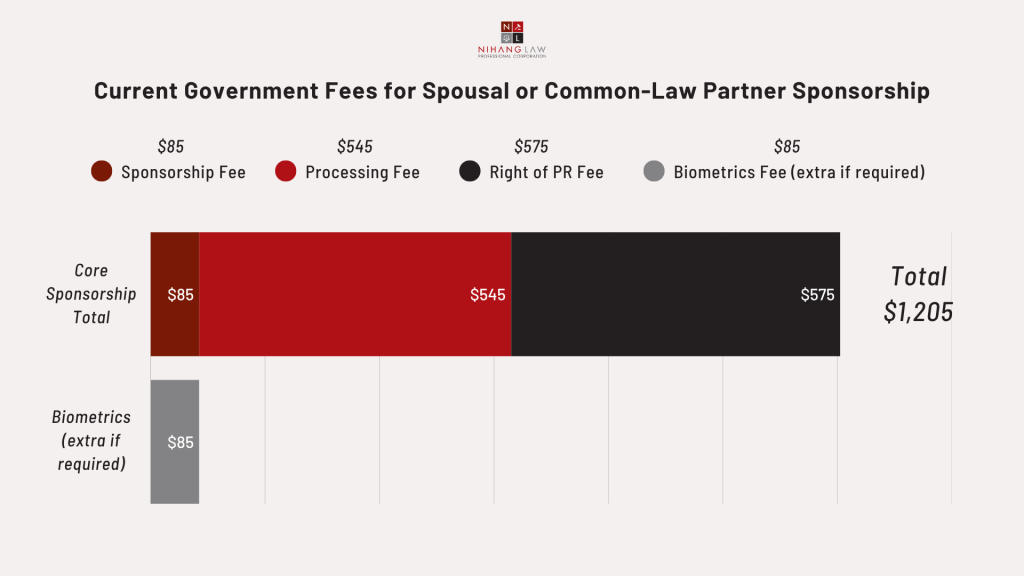
- Pay the right fees. Current spouse/partner sponsorship fees are $1,205 for the sponsorship fee, principal applicant processing fee, and right of permanent residence fee, plus biometrics where required.
- Consider work permit timing. If filing inland and eligible, review the open work permit option.
Figure 2: Current Government Fees for Spouse or Partner Sponsorship
Common Mistakes to Avoid
- Filing as spouses when the prior divorce is not yet effective and the new marriage has not lawfully happened.
- Counting cohabitation time that happened before physical separation from the legal spouse.
- Providing common-law proof, but little or no proof that the earlier marriage really ended.
- Assuming a separation agreement is mandatory, or assuming no documentary proof is needed at all. IRCC looks at the total evidence.
- Choosing inland without thinking about travel, status, or appeal consequences.
- Forgetting prior sponsorship bars, unpaid support, or earlier social assistance debts.
- Under-disclosing facts about the previous marriage, earlier children, or relationship timelines.
Frequently Asked Questions
Can I sponsor my boyfriend or girlfriend if I am only separated, not divorced?
Not just because you are separated. A boyfriend or girlfriend usually cannot be sponsored on that label alone. For most couples in this situation, the real question is whether you now meet the common-law definition through at least 12 consecutive months of genuine cohabitation after separation from your spouse.
Does the 12-month common-law period have to be continuous?
Yes, generally it must be 12 consecutive months of cohabitation in a conjugal relationship. IRCC says short and temporary absences may be acceptable, but long periods apart can undermine the claim. The evidence should show a real shared household and continuing interdependence.
Does time living together before I separated from my spouse count?
Usually that is the risky part. IRCC’s operational guidance says cohabitation with the common-law partner must start after physical separation from the spouse. Time that overlaps with an ongoing marital cohabitation can create serious category and credibility problems.
What if my divorce order has been granted but the 31 days have not passed yet?
Be careful. Under the Divorce Act, a divorce usually takes effect on the thirty-first day after judgment, unless the court orders an earlier effective date. Until then, you should avoid assuming the divorce is already final for sponsorship planning.
Can we apply inland if my partner is in Canada as a visitor?
Possibly. IRCC says the inland class can be available if the spouse or common-law partner lives with you in Canada and has valid temporary resident status, or is exempt from status requirements under a public policy. The facts should be reviewed carefully before filing.
Can my partner get an open work permit during the inland process?
Often yes, if the case fits IRCC’s current rules. IRCC says an eligible spouse or common-law partner in Canada may apply for an open work permit, usually once the AOR is issued, with a narrow exception for some near-expiry cases.
What if I was sponsored by a previous spouse less than five years ago?
That can block a new spouse or partner sponsorship. IRCC says a person who became a permanent resident through spousal or partner sponsorship generally cannot sponsor a new spouse or partner until five years have passed since they became a permanent resident.
Is the conjugal partner category an easier backup option?
Usually no. IRCC describes conjugal partner as a narrow class for a partner living outside Canada where marriage or cohabitation has not been possible because of legal, immigration, social, cultural, religious, or similar barriers. It is not the normal solution for incomplete common-law evidence.
Key Takeaways and How Nihang Law Can Help
If you are still legally married to your ex, the safest first step is not guessing the label. It is confirming whether your new relationship is actually ready for sponsorship under the common-law rules, whether the paper trail supports that position, and whether any sponsor bars or disclosure problems exist.
In many Ontario cases, the file can be viable before the divorce is formally final. But the dates, documents, and chosen sponsorship class have to line up. A careful review early on may prevent a refusal that takes far longer and costs far more to repair later.
Reminder: Sponsorship cases often turn on small factual details. This article is general information only and should not replace legal advice on your specific facts.
If you are navigating separation, divorce timing, or a new partner sponsorship, Nihang Law can review the relationship category, evidence strategy, and filing risks before an application is submitted.
Sources & References
Sponsor your spouse, partner, or child: Who you can sponsor
Sponsor your spouse, partner or child: Check if you’re eligible
Sponsor your spouse, partner or child: How to apply
Sponsor your spouse, partner or child: After you apply
Sponsor your spouse, partner or child: Optional: Open work permit in Canada
Infographic: A guide to sponsor your spouse, partner or child
How can my common-law partner and I prove we have been together for 12 months?
For my spousal sponsorship application, what is a common-law partner?
Citizenship and immigration application fees: Fee list
Immigration and Refugee Protection Regulations (section 1)
Immigration and Refugee Protection Regulations (section 4)
Immigration and Refugee Protection Regulations (section 117)
Immigration and Refugee Protection Regulations (section 125)
Immigration and Refugee Protection Regulations (section 133)
IP 8: Spouse or Common-law Partner in Canada Class
OP 2: Processing Members of the Family Class
Supplementary Information for the 2026-2028 Immigration Levels Plan
SOCI – 2026‒2028 Immigration Levels Plan – November 17, 2025
Immigration and Refugee Protection Act (section 40)
Application to Sponsor, Sponsorship Agreement and Undertaking (IMM 1344)
Thank you for reading this post, don't forget to subscribe!