


This article is for informational purposes only and does not constitute legal advice. Every legal situation is unique — consult a licensed lawyer before making any legal decisions.
Quick Answer: What Is the 2026 Ontario HST Rebate?
Quick Answer
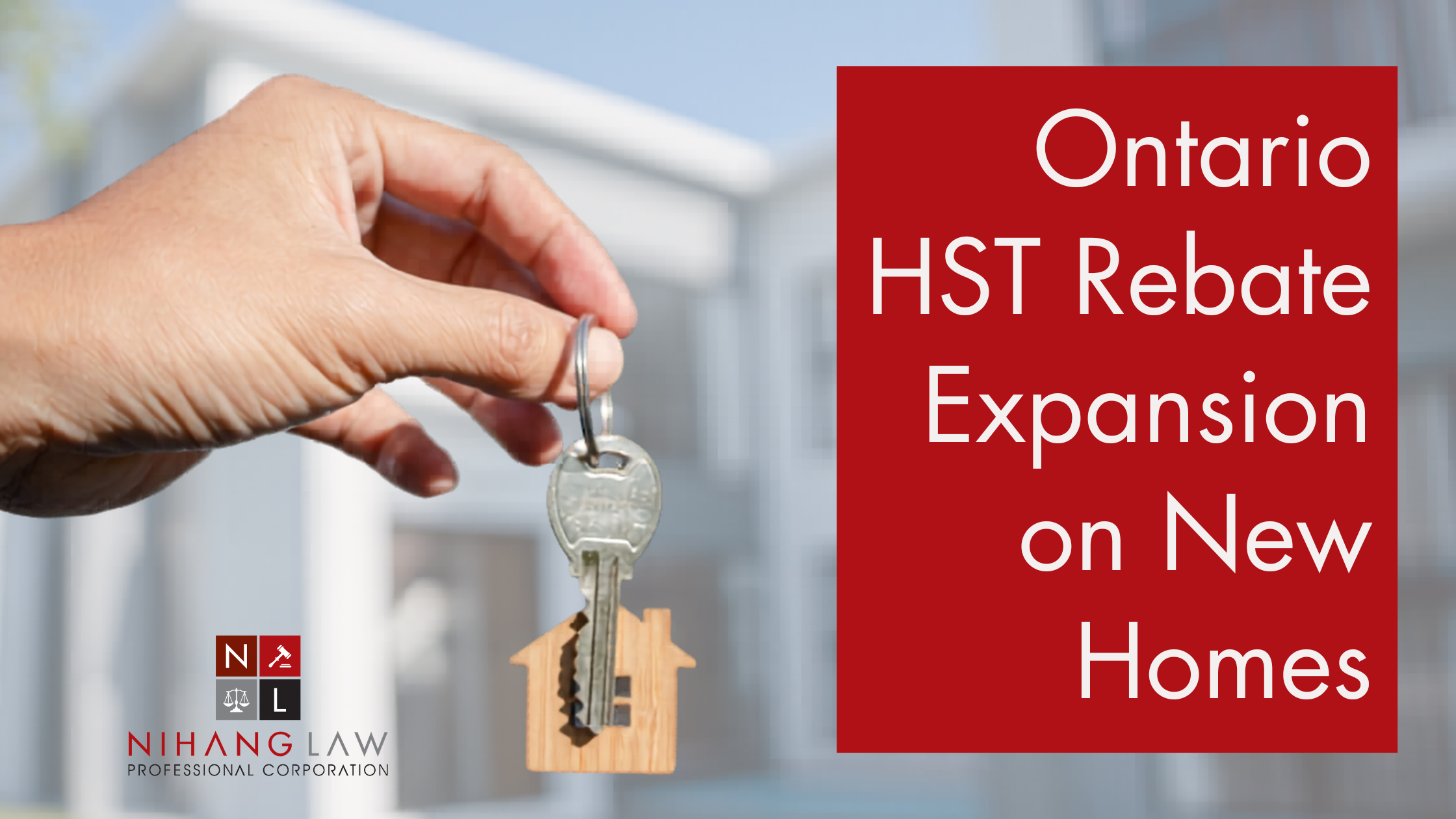
Ontario's 2026 HST rebate expansion may eliminate up to $130,000 in combined federal and provincial sales tax on eligible new home purchases — the largest HST relief on residential property in Ontario's history.
The rebate applies to all eligible buyers — not only first-time buyers — who sign an Agreement of Purchase and Sale (APS) between April 1, 2026 and March 31, 2027. For homes priced at or below $1,000,000, the full 13% HST may be rebated. For homes priced between $1,000,000 and $1,500,000, the maximum rebate is $130,000. For homes between $1,500,000 and $1,850,000, the rebate declines proportionally to a floor of $24,000. Homes over $1,850,000 receive the existing $24,000 maximum only.
As of May 2026, the enhanced rebate is proposed and subject to the passage of amendments to the federal Excise Tax Act. Royal Assent has not yet occurred. Buyers who have already signed within the qualifying window may be eligible, but should consult a real estate lawyer before assuming the rebate will apply to their closing.
The rebate also extends to qualifying new residential rental properties under a parallel program called the New Residential Rental Property Rebate (NRRPR).
A One-Year Window You Need to Know About
On March 25, 2026, the Ontario government announced the most significant change to residential HST rules in the province's history. For twelve months — covering Agreements of Purchase and Sale signed between April 1, 2026 and March 31, 2027 — eligible buyers of newly constructed homes may claim a combined federal and provincial rebate of up to $130,000. In a housing market where new condos in Toronto regularly start above $700,000, that is a real and substantial saving.
Before 2026, Ontario's real estate law landscape offered modest HST relief at best. The existing New Housing Rebate provided a maximum of $24,000 — and only on homes priced below $450,000. Most GTA new-build buyers received nothing. That changes entirely for purchases made within this window.
But the window is fixed. If your Agreement of Purchase and Sale — the binding contract signed with your builder — is dated before April 1, 2026 or after March 31, 2027, the enhanced rebate does not apply. This article explains who qualifies, what the critical deadlines are, and how to protect your eligibility from the risks most buyers only discover at closing.
(homes under $450K only)
(homes up to $1.5M)
Apr 1, 2026 – Mar 31, 2027
repeat buyers eligible too
Pick Your Path: Which Buyer Are You?
Find your situation below. Each path highlights the sections most important to your purchase.
What Changed: Old Rules vs. the 2026 Enhancement
The Harmonized Sales Tax — HST — is a 13% tax on newly constructed homes in Ontario. It is made up of two parts: the federal Goods and Services Tax (GST, 5%) and the Ontario provincial portion (8%). Both components are governed by the federal Excise Tax Act, R.S.C. 1985, c. E-15 — the statute that sets the rules for all GST and HST in Canada.
Before 2026, Ontario buyers had access to a New Housing Rebate (NHR) that phased out entirely once a home's purchase price exceeded $450,000. Because most new homes in Toronto, Scarborough, Mississauga, and Brampton are priced above that level, the majority of GTA buyers received nothing. The 2026 enhancement changes this across four price bands:
- Homes up to $1,000,000: the full 13% HST may be rebated — up to $130,000 combined
- Homes between $1,000,000 and $1,500,000: maximum rebate of $130,000
- Homes between $1,500,000 and $1,850,000: rebate declines proportionally from $130,000 to $24,000
- Homes over $1,850,000: the existing $24,000 maximum continues to apply
Important: as of May 2026, the federal portion of this rebate requires amendments to the Excise Tax Act that have not yet received Royal Assent. The Ontario and federal governments have agreed in principle, but this is not yet enacted law. Do not make binding financial decisions based solely on the announced rules without first consulting a real estate lawyer.
Nihang Law Professional Corporation
Old vs. New Rebate Thresholds: What Changed in 2026
Maximum HST rebate available by purchase price — Ontario new construction only
| Purchase Price | Pre-2026 Max Rebate | 2026 Max Rebate | Increase |
|---|---|---|---|
| Up to $450,000 | $24,000 | $58,500 | +$34,500 |
| $450,000 – $1,000,000 | $0 | Up to $130,000 | Up to +$130,000 |
| $1,000,000 – $1,500,000 | $0 | $130,000 (flat) | +$130,000 |
| $1,500,000 – $1,850,000 | $0 | $130,000 → $24,000 | Declining |
| Over $1,850,000 | $0 | $24,000 | +$24,000 |
Source: Government of Ontario, 2026 Budget — budget.ontario.ca/2026/hst.html. Canada Revenue Agency, Excise Tax Act, R.S.C. 1985, c. E-15. | Nihang Law Professional Corporation · Law Society of Ontario
Who Qualifies for the 2026 Rebate
Owner-Occupiers
If you are buying a new home to live in as your primary residence, you may qualify if all three of these conditions are met: your APS is signed between April 1, 2026 and March 31, 2027; construction of the home begins on or before December 31, 2028; and the home is substantially completed on or before December 31, 2031. Whether this is your first home or your fifth makes no difference — the 2026 expansion removes the first-time buyer restriction entirely for purchases within this window.
The key legal test is whether the home will be your primary place of residence, or the primary place of residence of a “close relative” — a term that has a specific meaning under the Excise Tax Act and should not be assumed. Your real estate lawyer can confirm whether your situation meets this definition.
Investors and Rental Buyers
The 2026 expansion also covers qualifying new residential rental properties through the New Residential Rental Property Rebate (NRRPR). Eligibility depends on when construction began:
- Sub-stream A (construction began before March 31, 2026): eligible if the APS is signed between April 1, 2026 and March 31, 2027, and the home is substantially completed by December 31, 2029.
- Sub-stream B (construction begins on or after April 1, 2026): eligible if construction begins by March 31, 2027 and is substantially completed by December 31, 2029.
The rental property must be for long-term residential use. Short-term rental arrangements — such as Airbnb or vacation rental use — do not qualify.
Newcomers and Permanent Residents
The rebate's primary eligibility test is whether the home will be your principal place of residence in Canada — not whether you hold Canadian citizenship or permanent residency. Newcomers purchasing a new home as their principal residence may qualify under this test.
That said, questions about how your immigration status interacts with your mortgage qualification, title registration, or overall HST rebate eligibility are best confirmed with a real estate lawyer before you sign anything. These details matter and can affect your claim.
Nihang Law Professional Corporation
HST Rebate Savings by Purchase Price
Old program vs. 2026 Enhanced Rebate — Ontario new home buyers
Pre-2026 Max Rebate
$24,000
Homes under $450K only
2026 Maximum Rebate
$130,000
Homes up to $1.5M
Maximum New Benefit
+$106,000
Increase over old program
Source: Government of Ontario, 2026 Budget — budget.ontario.ca/2026/hst.html. Data reflects proposed rebate subject to passage of federal Excise Tax Act amendments. | Nihang Law Professional Corporation · Law Society of Ontario
Your Step-by-Step Roadmap to Claiming the Rebate
The rebate is not automatic — it requires a chain of decisions, each one building on the last. Here is what a well-prepared buyer does from first inquiry to final claim.
-
1
Confirm Your APS Is Within the Eligible Window
Check that your Agreement of Purchase and Sale — the binding contract you sign with your builder — is dated on or after April 1, 2026 and on or before March 31, 2027. This is the hard eligibility trigger. The APS date is the date both parties signed the contract; it is not the date you removed a condition, paid a deposit, or received your occupancy date. One day outside this window means the old rules apply.
-
2
Have a Real Estate Lawyer Review the APS Before You Sign
Before committing, have a real estate lawyer review the HST clauses in your Agreement of Purchase and Sale. Your lawyer can confirm how the builder has structured the rebate — whether it is being credited directly to you at closing or whether you will need to claim it from the CRA separately. This is the most important step most buyers skip and most regret.
-
3
Verify Construction Deadlines Match Your Builder's Schedule
For a primary residence, construction must begin on or before December 31, 2028 and be substantially completed on or before December 31, 2031. Obtain written confirmation from the builder that their project timeline meets both of these requirements. Pre-construction condo towers frequently have optimistic timelines — if your building's expected occupancy is several years away, confirm in writing when the builder plans to break ground.
-
4
Understand How the Rebate Appears on Your Closing Documents
In standard practice, builders credit the rebate directly on the statement of adjustments — the financial summary prepared at closing — which reduces the net price you pay. However, because the Excise Tax Act amendments have not yet received Royal Assent, buyers who close before the legislation passes may need to apply to the Canada Revenue Agency directly using Form GST190, once the law is in force. Your real estate lawyer will advise which path applies to your specific closing.
-
5
Retain Your Documentation and Monitor Legislative Updates
Keep copies of your signed APS, all builder correspondence, and your closing documents. These records confirm your APS date and your intended use of the home — both of which the CRA may require when processing your rebate claim. Once the Excise Tax Act amendments receive Royal Assent, the CRA is expected to update Form GST190 to reflect the enhanced claim process. Bookmark this page — Nihang Law will update it when the legislation is confirmed.
Nihang Law Professional Corporation
2026 HST Rebate — Key Dates at a Glance
All critical windows and construction deadlines for Ontario new home buyers
Months shown are from April 2026 (Month 0). The APS window (Months 0-12) is the signing deadline. Construction and completion deadlines extend beyond the signing window — your project must meet these even after the APS window closes.
Source: Government of Ontario, 2026 Budget HST on New Homes — budget.ontario.ca/2026/hst.html. Dates subject to final enacted legislation. | Nihang Law Professional Corporation · Law Society of Ontario
Assignment Sales and Pre-Construction Condos: Special Rules That Can Void Your Rebate
Assignment sales are common in the GTA pre-construction condo market. When you buy an assignment, you purchase the rights to an existing purchase agreement — you step into the legal position of the original buyer. To qualify for the 2026 enhanced rebate, the original APS between the first buyer and the builder must also fall within the April 1, 2026 to March 31, 2027 window, not just your assignment agreement.
There is a second layer of tax to understand. The assignment premium — the profit the original buyer receives by selling the contract to you — is a separate taxable supply that attracts HST. That HST on the premium is not covered by the new rebate. To put this in concrete terms: if the original buyer is selling their contract for a $50,000 profit, you may owe approximately $6,500 in HST on that amount alone, on top of any other costs. Many buyers discover this figure for the first time on their final statement of adjustments.
For any assignment deal, have both a real estate lawyer and — if the sums involved are significant — a tax lawyer review the transaction before you commit.
Seven Mistakes That Can Cost You the Rebate
These are the errors most commonly made by Ontario buyers — many of which are discovered too late to fix.
- Signing the APS Before April 1, 2026 and Assuming You QualifyThe enhanced rebate applies exclusively to APS agreements signed within the April 1, 2026 to March 31, 2027 window. A purchase agreement dated March 30, 2026 — even by a single day — falls under the old rules, with a maximum rebate of $24,000.
- Assuming the Rebate Is Already LawAs of May 2026, the full combined $130,000 rebate requires passage of federal Excise Tax Act amendments — Royal Assent has not yet occurred. Buyers who negotiate a builder's price based on the rebate, but close before the law passes, may not receive a builder credit at closing and may need to apply to the CRA directly after enactment.
- Buying an Assignment Without Checking the Original APS DateIn an assignment sale, it is the original APS between the first buyer and the builder that determines rebate eligibility — not the date you signed the assignment agreement. If the original APS was dated before April 1, 2026, the enhanced rebate does not apply to you, regardless of when you purchased the assignment.
- Not Accounting for HST on the Assignment PremiumEven if the underlying property qualifies for the rebate, the assignment premium is a separate taxable supply subject to HST — not covered by the new rebate. On a $50,000 assignment profit, this represents approximately $6,500 in additional, non-rebatable tax.
- Adding a Co-Owner to Title Who Does Not Intend to Live in the HomeUnder the Excise Tax Act, if any person registered on title does not qualify — meaning they do not intend to use the home as their primary residence and are not a “close relative” as defined in the legislation — the entire rebate may be forfeited. Even a 1% ownership share by a non-qualifying party can void the full rebate claim.
- Relying on the Builder to Handle the Rebate Without Confirming It in WritingNot all builders automatically credit the rebate on the statement of adjustments — particularly during the current pre-legislation period. Before signing your APS, confirm in writing how the builder intends to treat the rebate, and have a real estate lawyer review the relevant HST clauses in the agreement.
- Assuming Resale Homes QualifyThe Ontario HST rebate applies exclusively to newly constructed homes and substantially renovated properties. Resale homes are not subject to HST and therefore do not qualify for any portion of this rebate — a distinction many buyers only realise after seeing the $130,000 headline figure.
Frequently Asked Questions
How does the $130,000 HST rebate work in Ontario in 2026?
Do I qualify for the Ontario HST rebate if I already own a home?
What is the deadline to sign a purchase agreement to get the Ontario HST rebate?
Has the Ontario HST rebate legislation been passed yet?
Does the Ontario HST rebate apply to pre-construction condos?
Can a newcomer to Canada claim the Ontario HST rebate on a new home purchase?
Does the HST rebate apply to investment properties and rental homes?
What happens to the HST rebate if I am buying an assignment on a pre-construction home?
How does the HST rebate show up on my closing documents?
Can I lose the rebate after I have already claimed it?
Nihang Law Professional Corporation
Who Qualifies? Buyer Eligibility at a Glance
2026 Enhanced HST Rebate — Ontario new construction
| Buyer Type | 2026 Enhanced Rebate | First-Time Buyer Rebate | APS Window Required | Construction Deadline | Lawyer Review |
|---|---|---|---|---|---|
| First-Time Buyer | ✓ | ✓ | ✓ | ✓ | ⚠ |
| Repeat / Move-Up Buyer | ✓ | ✗ | ✓ | ✓ | ⚠ |
| Investor (Rental) | ⚠ | ✗ | ✓ | ✓ | ✓STRONGLY |
| Newcomer / PR | ⚠ | ⚠ | ✓ | ✓ | ✓STRONGLY |
| Assignment Buyer | ⚠ | ⚠ | ⚠ | ✓ | ✓STRONGLY |
| Custom Build | ⚠ | ⚠ | ⚠ | ✓ | ✓STRONGLY |
Source: Government of Ontario, 2026 Budget — budget.ontario.ca/2026/hst.html. Segal GCSE LLP, Osler LLP. This table is for informational purposes only and does not constitute legal advice. Consult a licensed real estate lawyer before making any purchase decisions. | Nihang Law Professional Corporation · Law Society of Ontario
How Nihang Law Helps You Protect Your Rebate at Closing
Claiming an HST rebate worth up to $130,000 is not as automatic as the headline figure suggests. Three things can quietly go wrong between signing and closing: the APS may contain HST clauses that do not correctly account for the rebate; the statement of adjustments may fail to credit the full amount; or a co-owner on title may unknowingly disqualify your entire claim. None of these problems need to surprise you.
At Nihang Law, our real estate team reviews Agreements of Purchase and Sale before you sign, verifies rebate amounts on your statement of adjustments at closing, and identifies any title co-ownership structure that may put your claim at risk. We serve buyers across Toronto, Scarborough, Mississauga, and the broader GTA — including newcomers purchasing their first Canadian home who are navigating the Canadian tax system and property market simultaneously.
Led by Qasim Ali, Principal Lawyer at Nihang Law, our real estate practice is built on the belief that clear legal guidance before you sign is always more valuable than difficult conversations after the fact. A real estate consultation before you commit may be the most financially valuable hour you spend on this purchase.
Ready to protect your rebate?
Our real estate team can review your APS, verify your rebate eligibility, and protect your closing — before you sign anything.
Book a Real Estate Consultation
About the author
Qasim Ali
Principal Lawyer · Nihang Law Professional Corporation · Toronto & Scarborough, Ontario · Law Society of Ontario
Qasim Ali is the Principal Lawyer at Nihang Law Professional Corporation, serving clients across Toronto, Scarborough, and the broader Greater Toronto Area. He provides full-service legal representation across immigration, real estate, family law, criminal law, civil litigation, employment law, wills and estates, and business law.
Nihang Law is particularly recognized for its depth in immigration and real estate law — a combination that serves newcomers and growing families navigating both legal systems simultaneously.
Learn more about Qasim Ali →Sources & References
- Government of Ontario — 2026 Ontario Budget: HST on New Homes. budget.ontario.ca/2026/hst.html
- Government of Ontario — 2026 Budget: Keeping Costs Down (Chapter 1B). budget.ontario.ca/2026/chapter-1b-costs.html
- Aird Berlis LLP — “2026 Ontario Budget: Enhanced HST Relief on New Homes” (March 31, 2026). airdberlis.com
- Osler, Hoskin & Harcourt LLP — “Ontario's New HST Rebate: Key Details” (April 1, 2026). osler.com
- Segal GCSE LLP — “Ontario's Expanded HST Rebate for New Housing.” segalgcse.com
- Kelly Santini LLP — “New HST Rebate for All New Build Home Purchases.” kellysantini.com
- CBC News — “Ontario Plans to Remove HST on New Homes for 1 Year” (March 26, 2026). cbc.ca
- Deeded.ca — “Ontario's $130K HST Rebate Promise is Still Stuck in Limbo” (April 2026). deeded.ca
- Canada Revenue Agency — Excise Tax Act, R.S.C. 1985, c. E-15. laws-lois.justice.gc.ca
- Canada Revenue Agency — Form GST190, GST/HST New Housing Rebate Application. canada.ca
Thank you for reading this post, don't forget to subscribe!