




6th April 2026BY Nihang Law
ATIP and GCMS Notes for Canadian Immigration Applications
Access to Information and Privacy (ATIP) is the federal access-request process used to obtain records from government institutions. For immigration matters, requesting “GCMS notes” means you are asking for internal records pulled from IRCC’s Global Case Management System —the system officers use to process immigration, citizenship, and passport matters
IRCC and other federal institutions generally have 30 days to respond to a formal request, though extensions are permitted in some cases. Since July 29, 2025, IRCC has started proactively including officer decision notes with certain refusal letters, which means not every refusal now requires a separate GCMS request.
Last Updated: April 2026
A refusal letter or a long period of silence from IRCC can leave applicants guessing. Was the officer concerned about finances, ties to the home country, travel history, work experience, credibility, completeness, medical issues, or something else entirely? That uncertainty is nerve-wracking and could have a profound effect on one’s future.
A weak reapplication may repeat the same problem. A delayed response may affect work, study, travel, or family plans. In more serious files, waiting too long can also affect review rights.
For applicants in Ontario, the governing immigration law is federal, but the practical problem is immediate and local: you need to know what is actually in the government file before deciding whether to reapply, respond, or escalate. ATIP and GCMS notes can give that visibility, but only if you choose the right route, use the right consent, and do not let the notes request distract you from any live legal deadline.
Disclaimer: This article is general information only, not legal advice. Immigration strategy depends on the type of application, the refusal grounds, the record already disclosed, and any review deadline that may apply.
Quick Start: Pick Your Situation
I was refused and want to know the real reason.
- Check whether your refusal already includes officer decision notes. If not, an ATIP request may still be useful.
I am outside Canada and want my own file.
- A Privacy Act request may now be available even from outside Canada for your own personal information.
My lawyer or relative in Canada is requesting for me.
- Make sure the correct consent form is included.
I need CBSA travel history or border records.
- Consider whether the record is really held by CBSA rather than IRCC.
I am thinking about judicial review.
- Do not assume the ATIP process pauses the Federal Court deadline.
What are ATIP and GCMS notes in a Canadian Immigration File?
ATIP is the legal process used to request federal records, while GCMS notes are the actual internal case records and officer notes extracted from the government’s system. In short, ATIP is the process, and GCMS is the source.
While people commonly say they want to “order GCMS notes,” what they are legally doing is making a formal request under the Privacy Act or the Access to Information Act to access those specific immigration records.
What GCMS Notes Reveal
The Global Case Management System (GCMS) is Immigration, Refugees and Citizenship Canada’s (IRCC) integrated, worldwide electronic system used to process applications. Because it tracks everything, these notes can reveal far more than a standard, short refusal letter. Depending on your file, requesting these records may uncover:
- Status history
- Officer entries
- Activity codes
- Document review comments
- Admissibility stages
- Other case-processing remarks
Nihang Law Insight
GCMS notes are most valuable when the refusal wording is generic, the file is fact-heavy, or the applicant is considering a second application and wants to avoid repeating the same weakness.
The table below compares the tool, the record, and the automatic refusal explanation, because applicants often use these terms interchangeably even though they are not the same thing.
Item | What it is | Where it comes from | How you get it | Cost | Best Use Case | Limits or Cautions |
ATIP request | The formal legal process for requesting records from a federal institution | IRCC, CBSA, or another federal body | Submitted under the Privacy Act or Access to Information Act | Free under the Privacy Act for your own personal information; $5 under the Access to Information Act with IRCC | Use when you need the government file, internal records, travel history, or a better understanding of a decision | ATIP is the request mechanism, not the record itself; the usefulness depends on what records exist and which institution holds them. |
GCMS notes | Internal case records and officer notes from IRCC’s Global Case Management System | IRCC’s GCMS | Usually obtained through an ATIP request | Usually no separate cost beyond the route used to request them | Useful after refusals, unexplained delays, or before deciding whether to reapply or escalate | Not every line will be disclosed; some material may be redacted, and some files may also involve records outside GCMS. |
Officer decision notes | The deciding officer’s notes explaining a refusal | IRCC | For certain refusal types, IRCC now proactively includes them with the refusal letter | No separate request fee when provided automatically | Best first stop after a covered refusal, because they may already explain the concerns without a separate GCMS request | Currently phased in for certain application types only, and some portions may still be excluded for security, privacy, or other concerns. |
Who Can Request GCMS Notes and Which Act Should You Use?
The right route depends on who is asking, their location, and whether the request is for their own information or someone else’s. For most immigration applicants, the practical choice comes down to a free Privacy Act request for their own records, or a $5 Access to Information Act request, which is commonly used when a Canadian representative applies on their behalf.
The Privacy Act (Free)
Under IRCC’s current guidance, you should use this route to request your own personal information.
- It carries no fee.
- Who can apply: Canadian citizens, permanent residents, and foreign nationals, regardless of where they are located. This reflects the recent expansion of access through the Privacy Act Extension Order, No. 3.
The Access to Information Act ($5 Fee)
This route is often used when a representative in Canada is requesting records on behalf of someone else.
- It carries a $5 fee.
- Who can apply: The requester must be a Canadian citizen, a permanent resident, or an individual or corporation currently in Canada.
Crucial Warning: The Consent Threshold
A detail many people miss when requesting records on behalf of someone else is the consent threshold, which differs depending on the Act you use:
- Access to Information Act: Consent is required for each person on the file who is over 18.
- Privacy Act: Consent is required for each person on the file who is 16 or older.
Route Comparison Summary
Route | Best for | Who can use it | Fee | Consent point |
Privacy Act request | Your own personal immigration records | Canadians, PRs, and foreign nationals regardless of location | No fee | Needed if someone else requests on your behalf; IRCC notes 16+ on the file |
Access to Information Act request | Requests made through a Canadian representative or requests not limited to your own personal information | Canadian citizen, PR, or individual/corporation currently in Canada | $5 | IRCC notes consent for each person over 18 on the file |
Proactive officer decision notes | Certain refused temporary applications | Sent automatically with refusal letter in listed categories | No fee for the notes themselves | Not a substitute for every record type |
Table summary based on IRCC’s current ATIP guidance, Treasury Board guidance, and IRCC’s officer decision notes update.
When are GCMS Notes Worth Requesting After a Refusal or Delay?
GCMS notes are highly valuable when you need to understand a vague decision or strategically plan your next steps. However, they are less urgent if your refusal letter already includes clear notes and the core issue is easily fixable.
When to Request GCMS Notes
You should generally proceed with an ATIP request for GCMS notes when:
- The refusal is vague.
- The next application must directly address officer concerns.
- The file involves procedural complexity.
- Counsel needs the record for a strategic review.
The Shift to Proactive Notes
Since July 29, 2025, IRCC has been proactively providing officer decision notes directly with refusal letters for temporary resident visas, visitor records, study permits, and work permits (including extensions). More application types will be added over time. However, note that parts of these records may still be excluded for security, privacy, or similar concerns.
Your New First Step After a Refusal
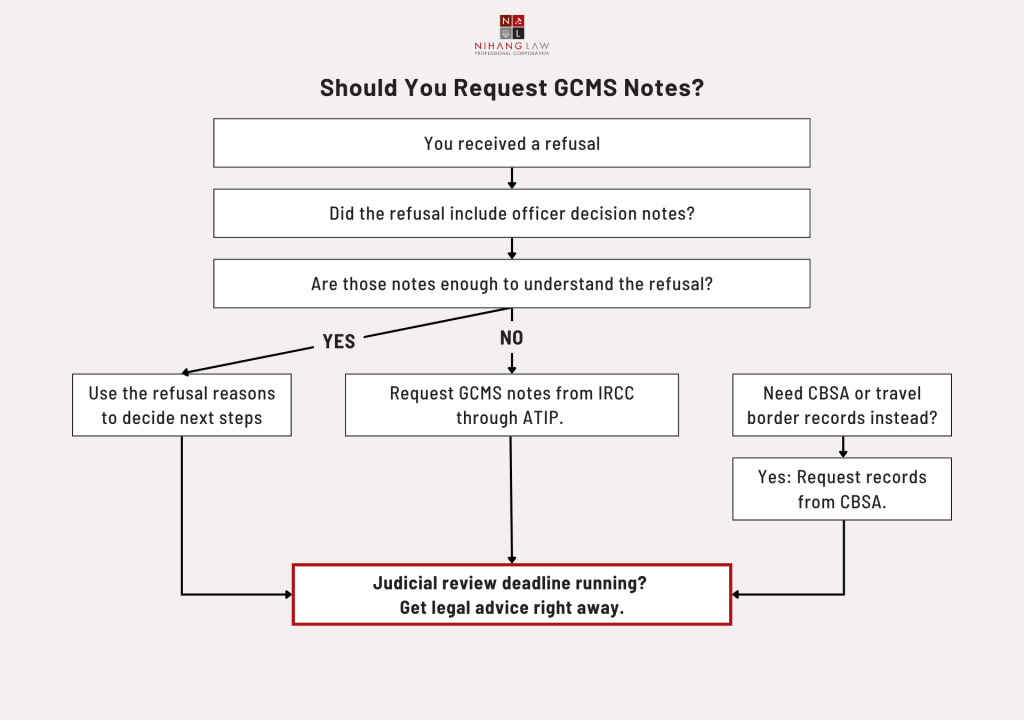
Because of this update, the first question after a refusal is no longer automatically, “Should I order GCMS notes?”
Instead, you should ask: “Did the refusal letter already include enough notes to understand the decision?”
- If yes: The more important issue may be whether your evidence needs to change for a future application.
- If no: The standard ATIP process will still be very useful for uncovering the missing context.
Nihang Law Insight
In reapplication files, the real value of notes is not curiosity. It is issue-spotting. A better second application usually does not just add more documents; it answers the exact concern the officer recorded.
How Do You Request GCMS Notes from IRCC Step-by-Step?
The safest process is to identify the institution holding the record, choose the correct Act, gather consent, file through the ATIP Online Request tool, and describe the records precisely. A focused request is usually easier to process than a vague demand for “everything.”
1. Choose the institution that likely holds the record
IRCC is the usual starting point for immigration application notes. But if the issue is border travel history, enforcement-related records, or certain entry/exit data, CBSA may be the better institution or an additional one to request from. CBSA confirms that a Travel History Report is a record of a traveller’s entries, exits, or both into Canada.
2. Choose the correct legal route
If you want your own personal information, use the Privacy Act route where available. If a representative in Canada is requesting on behalf of a foreign national, or the request is not limited to the requester’s own personal information, the Access to Information Act route is often used.
3. Prepare the consent properly
IRCC uses IMM 5744 for consent to release information in this context. Missing or incomplete consent is one of the easiest ways to create avoidable delay.
4. File online and be specific
IRCC says electronic requests should be submitted through the ATIP Online Request tool. The governing statutes also require enough detail to let an experienced employee identify the records with a reasonable effort. In practice, include identifiers such as the application number, UCI, applicant name, date of birth, application type, and a focused description of the records requested.
5. Track the file and respond to clarification requests
Treasury Board’s current ATIP Online guidance says your account can show status updates, allow secure messaging with the ATIP officer, and even provide completed records before the full package is finished.
How Long Do ATIP and GCMS Notes Take, and What Can Delay Them?
The baseline statutory response period is 30 days under both the Access to Information Act and the Privacy Act, but extensions are allowed. Delays are more likely to happen if the request is broad, consultations are needed, or the institution is dealing with high volumes.
Statutory Deadlines and Extensions
Treasury Board guidelines state that federal institutions have 30 days to respond to access or personal-information requests. However, extensions are allowed, provided the requester is notified within the first 30 days:
- Access to Information Act: Extensions may be taken if there are many records or if external consultations are required.
- Privacy Act: Institutions may take up to 30 additional days if meeting the original deadline would unreasonably interfere with operations, or if consultations are necessary.
The Impact of IRCC Workloads
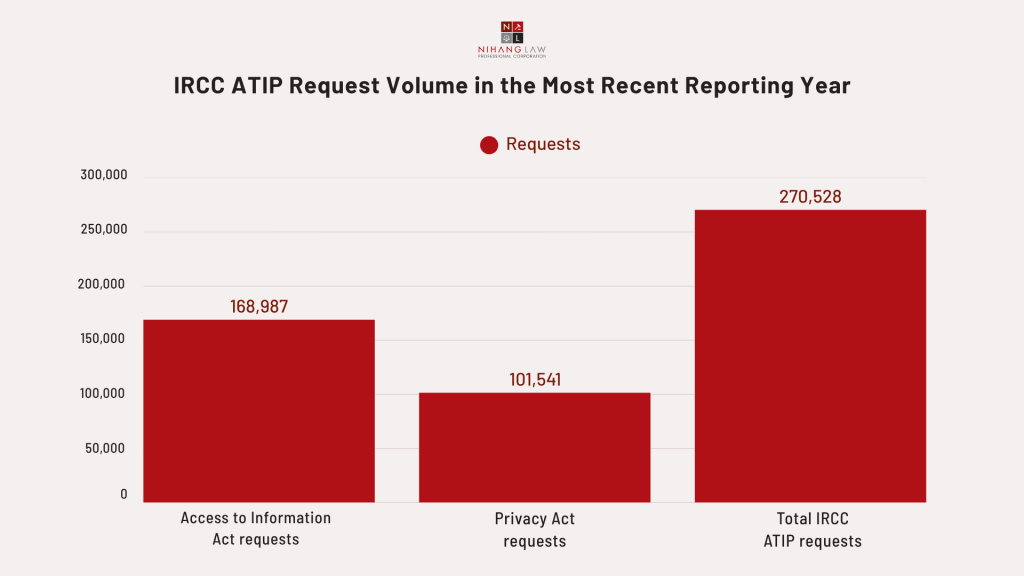
IRCC’s 2024–2025 annual reports reveal the massive scale of their ATIP workload. This high volume helps explain why some files move quickly while others do not—and why submitting a precise request matters. During that reporting period, IRCC processed a combined volume of 270,528 requests:
- Access to Information Act: 168,987 requests (with an 80.7% compliance rate).
- Privacy Act: 101,541 requests (with an 87% compliance rate).
Legal Perspective
If the matter involves a possible Federal Court challenge, do not wait for GCMS notes and assume the court deadline will wait too. The Federal Court’s immigration guide states that an application for leave and judicial review must generally be served and filed within 15 days for a matter arising in Canada or 60 days for a matter arising outside Canada.
What Do You Usually Receive, and Why Are Parts Sometimes Blacked Out?
A response will typically include internal records like GCMS entries and officer remarks, but you will likely see some blacked-out sections. These redactions do not automatically mean something improper happened. They simply reflect a lawful exemption where the government is legally required or permitted to withhold certain details.
What is Usually Disclosed
While not every single line will necessarily be disclosed, a standard response for an immigration file generally provides:
- GCMS entries
- Officer remarks
- Correspondence history
- Other internal administrative records
Why Information is Withheld
Treasury Board guidelines clarify that not all requested information can be released under the federal access statutes. Specific exemption provisions are built into the law to protect other critical interests. Your notes may be blacked out to protect:
- Privacy (especially personal information belonging to other individuals on the file)
- National security
- Law enforcement concerns
- Privileged information (such as solicitor-client privilege or litigation privilege)
How Do ATIP Requests Compare with Officer Decision Notes and Status Tools?
These tools serve distinctly different purposes. Status tools show processing progress, and proactive notes explain certain refusals, while ATIP requests are the broader, formal mechanism for obtaining your complete records. Ultimately, one tool does not fully replace the others.
The Purpose of Each Tool
Understanding when to rely on each option depends on what information you are trying to uncover:
- Status tools: Use these to confirm application receipt, messages, and general progress. However, they do not replace the need for a detailed record.
- Proactive officer decision notes: These automatically provided notes can now answer the core “why” behind a refusal for some temporary application categories.
- ATIP requests: This remains the formal legal route when you need the fuller record, need to understand a refusal that isn’t covered by proactive notes, or want records from another federal institution (such as the CBSA).
What Mistakes Do Applicants Commonly Make?
The most common mistakes are procedural rather than legal. People often choose the wrong Act, miss the consent requirement, request records from the wrong institution, submit a vague description, or wait too long when a strict legal deadline is already running.
Common Procedural Mistakes
To avoid unnecessary delays or rejections, be careful not to make these frequent errors:
- Asking the wrong institution: Requesting records from IRCC that are more likely held by the Canada Border Services Agency (CBSA).
- Choosing the wrong Act: Using the paid Access to Information route when a free Privacy Act request for your own file was available.
- Missing consent: Sending incomplete or missing consent forms for other individuals on the file.
- Submitting vague descriptions: Requesting “all records” without specific identifiers or date ranges, which can significantly slow down processing.
- Misinterpreting redactions: Assuming blacked-out text means the response is useless or that something improper occurred.
- Ignoring proactive notes: Reapplying immediately without checking whether your refusal letter already included officer decision notes.
- Missing legal deadlines: Waiting for ATIP notes to arrive when a judicial review deadline may already be actively running.
What Should You Do If You Are Considering a Reapplication or Judicial Review?
Start by identifying the decision type, the deadline, and whether reasons are already available. While a notes request may support a better reapplication or a legal review, it should not distract you from urgent filing timelines or from fixing obvious evidentiary gaps.
Deciding Between Reapplication and Notes
Your strategy should be guided by the clarity of the decision. If the refusal is narrow and clearly documented, you may be better off with a stronger reapplication. However, if the reasons are unclear, inconsistent, or potentially unreasonable, requesting the notes may be more important. Either way, timing matters.
Reminder: A notes request is an information-gathering tool. It is not, by itself, an appeal, a reconsideration request, or a suspension of any legal deadline.
Frequently Asked Questions
Are GCMS notes the same as ATIP?
GCMS notes are not the same thing as ATIP. ATIP is the legal request process. GCMS is IRCC’s case-management system, and the notes are one kind of record that may be disclosed through an ATIP request.
Can I request my own immigration notes from outside Canada?
Yes. For your own personal information, IRCC says foreign nationals can request access under the Privacy Act regardless of where they are located, reflecting the broadened access now recognized in law and policy.
How much does a GCMS or ATIP request cost?
A Privacy Act request for your own personal information is free. An Access to Information Act request carries a $5 fee with IRCC and CBSA.
How long does IRCC have to answer?
The general statutory timeline is 30 days, but extensions are permitted. For Privacy Act requests, the institution may take up to 30 additional days in the listed circumstances. For Access to Information Act requests, a reasonable extension may be taken in the situations set out by the Act.
Do I still need GCMS notes if my refusal letter already has officer decision notes?
Not always. Since July 29, 2025, IRCC has started proactively including officer decision notes with certain refusal letters. Sometimes those notes are enough to guide the next step; sometimes a broader ATIP package is still helpful.
Can my lawyer request the notes for me?
Yes, but the correct consent must usually be included. For IRCC, the commonly used consent form is IMM 5744, and the age-related consent points differ between the Access to Information and Privacy Act guidance.
Can I request CBSA records too?
Yes. CBSA has its own ATIP process, and some records, such as travel history reports, are specifically held by CBSA. The right institution depends on the record you actually need.
Do GCMS notes stop a Federal Court deadline?
No. A notes request does not automatically stop the time for judicial review. In immigration matters, the Federal Court guide says the filing period is generally 15 days for a matter arising in Canada and 60 days for one arising outside Canada.
Key Takeaways
ATIP and GCMS notes are often the most practical way to see what happened inside an immigration file, but they are only one part of a broader strategy. The ultimate goal is not to order notes just for the sake of ordering them—it is to use the record strategically and on time.
The Bigger Strategic Picture
In Ontario, many applicants only seek help after a refusal, but the most useful advice often starts earlier by choosing between a reapplication, further disclosure, or a time-sensitive legal response. Before making your next move, you need to ask the right questions.
- What decision was made?
- What reasons are already available?
- Which institution holds the record?
- Which Act applies?
- What deadline is running right now?
How Nihang Law Can Help
Nihang Law’s immigration team can help you assess your situation and determine the most effective path forward. We can review your file to evaluate whether:
- Your refusal already contains enough reasons.
- A targeted ATIP request is genuinely worthwhile.
- A stronger reapplication or a review strategy makes more sense in your specific circumstances.
Sources & References
Access to Information Act (Justice Laws)
Privacy Act Extension Order, No. 3 (Justice Laws)
IRCC — How to make a request under the Access to Information Act
IRCC — How to make a request under the Privacy Act
IRCC — Consent for an Access to Information and Personal Information Request (IMM 5744)
Treasury Board — How access to information and personal information requests work
Treasury Board — Track and receive your response
IRCC — Explaining application refusals: Officer decision notes
IRCC — Processing aids / GCMS overview
IRCC — 2024–2025 Annual Report on the Access to Information Act
IRCC — 2024–2025 Annual Report on the Privacy Act
CBSA — How to make a request under the Access to Information Act
CBSA — How to make a request under the Privacy Act
Federal Court — How to file an application for leave and for judicial review (immigration)
Thank you for reading this post, don't forget to subscribe!