



19th February 2026BY Qasim Nihang
2026 Express Entry: New Categories and Updated Eligibility Requirements
On February 18, 2026, IRCC announced the changes to Express Entry in 2026. And if you’re trying to become a permanent resident in Canada, it’s normal to feel like the goalposts keep moving.
The big headline from IRCC is that Canada is prioritizing top talent through the 2026 Express Entry Categories, including new targeted categories for physicians, certain transport roles, researchers, senior managers, and even specific Canadian Armed Forces recruits.
Moreover, IRCC’s updates in 2026 indicate that the work experience requirement for some renewed categories has increased from six months to one year. This change applies to categories like health care and trades, where Canadian or foreign work experience is considered.
These targeted categories aim to prioritize applicants with skills and experience Canada is seeking, but keep in mind that being in a targeted category does not automatically guarantee an invitation.
Disclaimer: This article is general information, not legal advice. Immigration rules can change, and outcomes depend on your facts. It is highly recommended that you speak with an immigration professional.
What’s My Situation?
Use this as your checklist to assess your situation:
If you’re a worker already in Canada (Ontario)
- Confirm your eligibility for Express Entry (CEC, FSW, or FST).
- Identify whether you fit a 2026 category (or French proficiency).
- Check the work experience minimum for the category you’re aiming for (now often 1 year for renewed categories).
- Gather proof: reference letters with job duties, pay stubs, and language tests.
If you’re outside Canada (or not working in your field yet)
- Focus on language scores and credential assessment planning (ECA where needed).
- Build a strategy around either a category path or French proficiency.
- Don’t rush-submit an Express Entry profile with weak documentation.
If you’re an Ontario employer hiring “hard-to-find” talent
- Decide early: LMIA route vs. LMIA-exempt options (where available).
- Align job duties, NOC, and offer terms to immigration requirements.
- Plan around Express Entry categories (and consider supporting PR strategy alongside work permits).
What IRCC Announced
IRCC confirmed that Express Entry in 2026 will continue to prioritize category-based invitation rounds to invite candidates who match targeted skills and experience that Canada wants right now.
Essentially, the Express Entry pool is like a waiting room, and category-based draws are when IRCC calls up certain people from the waiting room and gives them an opportunity to become permanent residents because they match a priority need in Canada (such as specific occupations or French skills).
This does not mean everyone in a category will be invited, or that having the right job title is a guaranteed pathway to PR. It means your profile is more likely to be competitive if it clearly fits a targeted category and you meet the program requirements behind Express Entry (whether it be under CEC, FSW, or FST).
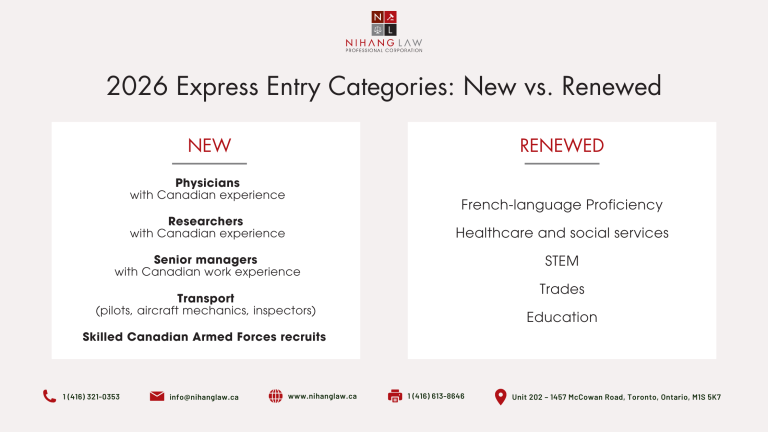
The 2026 Express Entry Categories (What’s New vs. Renewed)
New Categories for 2026
As part of their February 18, 2026 announcement, IRCC added new categories that focus on specific groups, including:
- Physicians with Canadian work experience
- Researchers with Canadian work experience
- Senior managers with Canadian work experience
- Transport occupations, including roles like pilots, aircraft mechanics, and inspectors
- Skilled foreign military recruits in key CAF roles (for example, military doctors, nurses, pilots)
Note: Those applying as skilled foreign military recruits, such as military doctors and pilots, there are specific provisions for CAF roles, which may require additional documentation and processes beyond the standard Express Entry criteria.
Renewed Categories Continuing from 2025
IRCC also confirmed it will continue invitation rounds for:
- French-language proficiency
- Health care and social services
- Trades
- STEM (Science, Technology, Engineering, and Mathematics)
- Education
There were also some changes to the NOCs that fall under some categories. For example, NOC Code 63200 for Cooks, which was previously in the Trades category, has been removed. Meanwhile, NOC Code 63201 for Butchers has been added to the Trades category.
Eligibility Criteria Update: 1 Year is the New Baseline
The IRCC’s 2026 updates indicate that the work experience requirement for some renewed categories has increased from six months to one year. This change applies to categories like health care and trades, where Canadian or foreign work experience is considered. This means applicants who previously thought they only needed six months of experience now need to meet a 12-month threshold.
Note: For categories like Physicians, Senior Managers, and Researchers, Canadian work experience is required. For categories like Trades, Health care, and STEM, work experience can be either in Canada or abroad.
What This Means in Ontario
Ontario is often where people land when they’re pursuing career growth, licensing pathways, major employers, and strong settlement supports.
So the Canada Express Entry changes in 2026 can affect Ontario applicants in very real ways:
- Workers already in Canada may benefit from continued emphasis on candidates with Canadian work experience.
- French language proficiency continues to be a highly valued skill, where bilingual workers are in demand across various industries. If you have French-language skills, this can significantly boost your chances in the Express Entry process.
- Trades and health remain core priorities, but the documentation burden (and the 1-year minimum) means planning ahead matters moreso now.
Step-by-step roadmap: From “Interested” to “Invitation-ready”
Use this roadmap whether you’re a worker or an employer planning a hire.
Step 1: Confirm your Express Entry program fit
Express Entry manages applications under major federal programs (CEC, FSW, FST) and can interact with provincial nomination. Categories help, but you still need to qualify under the underlying program rules.
Step 2: Identify your best category angle
Ask which 2026 Express Entry Categories best match your actual experience and plan. If you can credibly qualify for French proficiency, that can be a strong lane. If you’re in a renewed category, build to 1 year of experience, not 6 months.
Step 3: Build documentation like IRCC will challenge it
Your proof should show duties that match the occupation, paid employment, and dates/hours that align with what you’re claiming. Supporting records often matter.
Step 4: Lock your language strategy early
Language results affect competitiveness and can determine whether you qualify for the French category. Treat language as a project (booking tests, retakes, study time), not a last-minute checkbox.
Step 5: Employers — Decide LMIA vs. long-term PR support
For many Ontario employers, a two-track plan helps: short-term work authorization (where applicable) plus a long-term PR strategy aligned to categories.
Step 6: Keep your profile draw-ready
Category rounds can move quickly. You want to be ready before a draw happens, not scrambling after.
Physicians: A Clearer Path (But Still A Process)
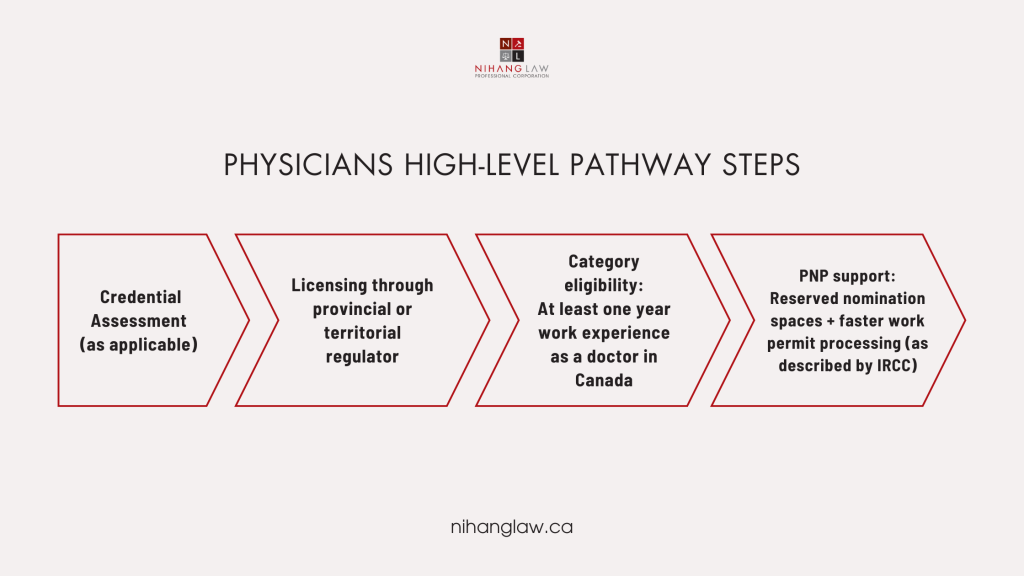
IRCC introduced a priority category for physicians with at least 12 months of full-time Canadian work experience.
While the 2026 updates to Express Entry provide a clearer path for physicians with Canadian work experience, applicants should be aware that licensing requirements vary by province, and obtaining provincial or territorial medical licensure is still required for practice in Canada.
Chart 2: Physicians High-Level Pathway Steps
Common Mistakes And How to Avoid Them
Here are issues we see that can derail otherwise strong candidates:
- Assuming the category is enough: You still need to qualify under the Express Entry program structure.
- Using job titles instead of duties: Decisions turn on what you actually did.
- Missing the “one-year” shift for renewed categories.
- Weak proof of work experience: Vague letters with missing duties or hours can create problems.
- Waiting too long on language tests.
- Relying on unofficial summaries instead of IRCC wording.
Frequently Asked Questions (FAQs)
Does this mean Express Entry is “easier” in 2026?
Not necessarily. It means IRCC is targeting who gets invited in some rounds. If you fit a category and have strong documentation, your chances may improve, but there are no guarantees.
If I’m in Ontario on a work permit, should I focus on Canadian Experience Class?
IRCC emphasized inviting candidates with Canadian work experience through CEC draws in early 2026. Whether that’s your best path depends on your profile and category fit.
What are the 2026 Express Entry categories?
They include new targeted categories:
- Physicians with Canadian work experience
- Researchers with Canadian work experience
- Senior managers with Canadian work experience
- Transport
- Skilled CAF recruits
And renewed categories:
- French proficiency
- Health care and social services
- STEM
- Trades
- Education
Note: Check the official IRCC page for eligibility criteria and the NOC codes eligible for each occupation category.
Is 6 months of work experience still enough?
For renewed categories, IRCC’s backgrounder states the minimum experience increased from six months to one year (in Canada or abroad) over the prior three years.
I’m a doctor. Does the new category mean I can skip licensing steps?
No. IRCC still emphasizes credential assessment and licensing through a provincial or territorial authority to work as a medical doctor in Canada.
If I’m an employer, can I use Express Entry instead of an LMIA?
Express Entry is primarily an applicant-driven permanent residence system. Whether an LMIA is required depends on the work authorization pathway. Consider getting tailored advice for your hiring plan.
Do these categories increase the total number of invitations?
IRCC states the number of invitations remains within the targets of the 2026-2028 Immigration Levels Plan and that additional categories do not increase invitations beyond that target.
How do I know if my occupation is eligible for a category?
Eligibility is tied to IRCC’s occupation lists and how your duties align with the occupation and the NOC codes included in each category. If you’re unsure, review your evidence before relying on a category strategy.
In Summary
Canada’s 2026 Express Entry direction is clear: targeted selection for top talent, with new categories and renewed priorities. For Ontario applicants and employers, the opportunity is real. But the margin for error is small.
If you want to take advantage of the 2026 Express Entry Categories, focus on choosing the right lane (category plus program fit), building documentation that matches what IRCC looks for, and treating language and work experience as timelines you actively manage (especially with the 1-year shift).
How Nihang Law Can Help
At Nihang Law Professional Corporation, we help individuals and Ontario employers plan immigration strategies that are practical, well-documented, and aligned with current IRCC guidelines, including how the Canada Express Entry changes in 2026 affect category selection and eligibility.
If you need help assessing your Express Entry pathway, strengthening your supporting documents, or building a hiring plan that supports long-term retention, contact Nihang Law to book a consultation with a legal professional.
Disclaimer: This is general information, not legal advice. The best strategy depends on your facts.
Thank you for reading this post, don't forget to subscribe!